Using controlled vibrations instead of light, scientists find a new way to link quantum devices, helping future computers and sensors work together.
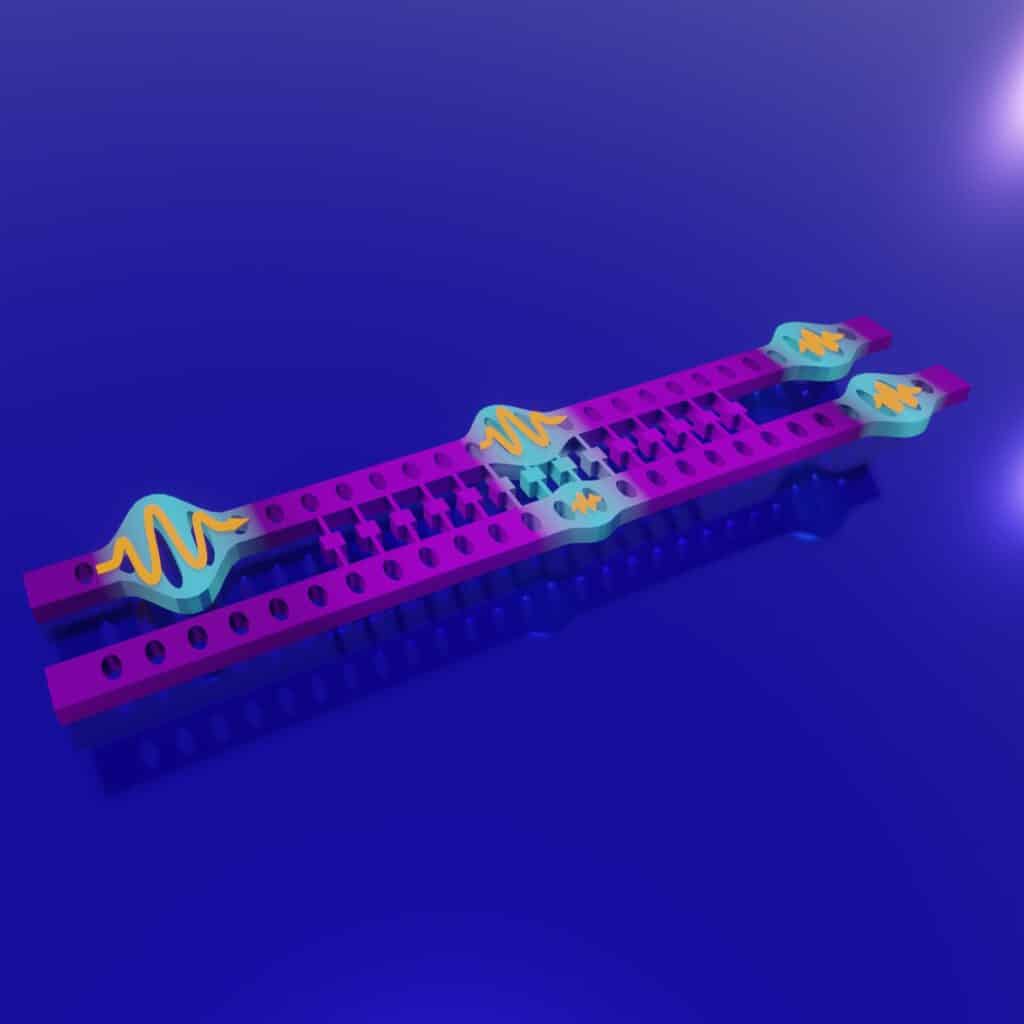
Scientists have built a chip that can split and control phonons, which carry information in quantum systems using vibrations. The goal of this research is to help different kinds of quantum computers and sensors share information easily.
Phonons are the sound-like equivalent of photons, but they travel much slower and need less energy. Because of these properties, they can connect different kinds of quantum devices more efficiently. This makes them useful for creating hybrid quantum systems, where one device processes information and another stores it.
This new device, called a four-port phononic directional coupler, uses vibrations to transfer quantum data.The new coupler acts like a junction that splits or combines vibrations travelling through a chip. It has four ports, two inputs and two outputs.
The device is made of silicon using nanoscale patterns that guide high-frequency vibrations, similar to how optical fibres guide light. The team controls the vibration path by changing the length of the coupling region, deciding how much energy goes to each output.
By cooling the chip at extremely low temperatures, the researchers confirm that the device can split single phonons reliably, working like a beam splitter used in optical systems but for sound waves at the quantum level.
This technology helps scientists link different types of quantum hardware. For example, fast superconducting qubits and long-lasting spin-based systems, to form quantum networks on a single chip. It can also improve quantum sensors that detect tiny movements or signals.
The research team at Delft University of Technology in the Netherlands plans to add more phononic components, reduce energy loss, and integrate the system with existing quantum computers. The work is a major step toward scalable, chip-based quantum communication and sensing systems built on mechanical vibrations instead of light.