

This flexible heart sensor aligns to the contours of the human body and was inspired by the old art of cutting paper, kirigami.
This sensor is actually a sheet that can stretch and breathe with the skin while recording ECG data. Cuts in a polyethylene terephthalate (PET) film printed with silver electrodes were used by Japanese scientists to fit the sensor on a person’s chest to monitor his or her heart. They were able to detect enough signal from the heart to be utilised in a smartphone app. The research is being led by from Kuniharu Takei, Osaka Prefecture University.
Unlike the genetically similar art of origami, which focuses solely on paper folding, kirigami includes paper cutting as well. This method enables relatively stiff materials, such as PET, to adapt to their surroundings.
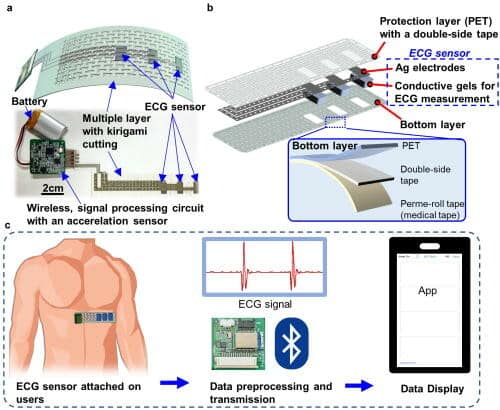
“In terms of wearability, by applying kirigami structure in a PET film, due to PET deformation and bending, the film can be stretchable, so that the film can follow skin and body movement like a bandage,” said Kuniharu Takei. “In addition, since kirigami structure has physical holes in a PET film, skin can be easily breathed through the holes.”
As firms strive towards wearables that are not that evident or easily visible, the focus has also shifted to improving the ability to distinguish electrical impulses from the heart from background noise. Devices that assure a tighter fit are therefore an appealing solution. The ideal sensor size, according to the researchers, is 200 square millimetres with 1.5 centimetres between electrodes.
“The major challenge was how to realize the kirigami structure without using a precise alignment process between the silver electrodes and kirigami cutting,” Takei said.
Their sensor-equipped device could properly and reliably communicate cardiac data of numerous people performing a variety of activities such as walking, or working while seated in a chair. The team’s next goal is to add more sensors that can measure a variety of data from the skin’s surface to aid in illness detection and future medical trials.
You can read the entire study here.