




Discover how this powerful open-source SPICE simulator helps you analyse and validate analog, digital and mixed-signal circuits long before hardware is built with detailed netlist control, real transistor models, and scriptable workflows to streamline your design process.
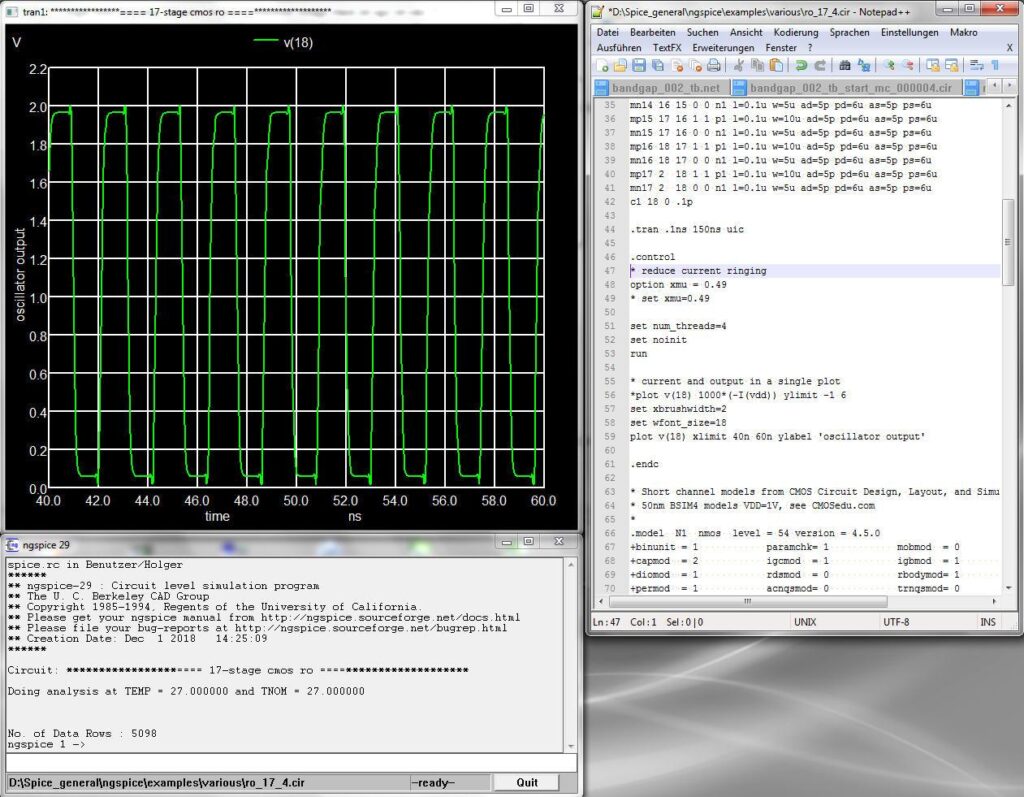
For any electronics design engineer, simulation is the first reality check. Before copper is laid on a PCB or silicon is committed to a mask set, circuit behaviour must be validated. This is where SPICE-based simulators come into play. Among them, NGSPICE has steadily evolved into one of the most capable open-source circuit simulation engines available today. Built on the foundations of Berkeley SPICE3, NGSPICE extends classical analog simulation into modern mixed-signal territory while remaining transparent, scriptable, and deeply engineer-centric.
NGSPICE is not a schematic toy. It is a numerical circuit solver that expects engineers to describe circuits explicitly, understand device behaviour, and interpret results critically. As one long-time user succinctly puts it, “NGSPICE doesn’t hide mistakes, it forces you to understand your circuit.” That philosophy shapes both its strengths and its learning curve.
It is a general-purpose SPICE simulator used to analyse electronic circuits by solving nonlinear differential equations derived from Kirchhoff’s laws. Engineers describe circuits using a netlist, a text-based representation of components, nodes, and connections. The simulator then performs various analyses such as DC operating point, AC small-signal response, transient time-domain behaviour, noise analysis, and parameter sweeps.
Unlike many commercial tools, it does not depend on a graphical interface to function. This design choice is deliberate. As one engineer notes, “Once you start editing the netlist directly, you realise how much control GUI tools quietly take away from you.” That control is crucial in advanced analog and mixed-signal work, where subtle modelling choices can significantly affect results.

Why Design Engineers Use NGSPICE
Its biggest advantage is compatibility. It supports PSPICE- and HSPICE-style netlists and works with most manufacturer-supplied SPICE models. This allows engineers to simulate real-world components powering MOSFETs, BJTs, op-amps, and IC macromodels without proprietary software.
However, compatibility alone does not make a simulator useful. Engineers often highlight NGSPICE’s numerical robustness. “It converges where some lightweight simulators simply give up,” remarks a user working on precision analog front ends. This is particularly important in circuits involving feedback, switching behaviour, or strong non-linearities.
Another reason NGSPICE remains relevant is its mixed-signal capability. Through XSPICE extensions and co-simulation support, engineers can simulate analog circuitry alongside digital logic described in Verilog or VHDL. In practice, this means you can validate an ADC’s analog front-end while running digital control logic in the same simulation. As one mixed-signal designer observes, “Even if it’s not as slick as commercial tools, NGSPICE gets the job done and you can see exactly what it’s doing.”
Device Models and Simulation Depth
It includes an extensive library of device models: resistors, capacitors, inductors, diodes, BJTs, MOSFETs, JFETs, MESFETs, and more. It also supports advanced compact models such as BSIM, VBIC, and increasingly, Verilog-A models through the OSDI interface.
This depth matters in modern design. Transistor-level simulations demand accurate modelling of parasitics, temperature effects, and process variations. Engineers appreciate that NGSPICE does not “simplify away” such effects unless explicitly told to do so. “If your model is bad, NGSPICE won’t save you and that’s actually a good thing,” comments a senior analog designer.
What’s new?
As of September 2025, the latest stable release is NGSPICE 45, with 45.2 providing incremental bug fixes. This release focused less on flashy features and more on engineering-grade refinements, which many users welcomed.
Key enhancements include improved mixed-signal co-simulation, especially VHDL support through GHDL, making NGSPICE more practical for complex system-level validation. Updated transistor models, including BSIM4.8.3, improve accuracy for modern CMOS nodes. Diagnostics have also been refined invalid .dc sweeps, misconfigured analyses, and internal variable handling now produce clearer error messages.
One user noted after upgrading, “The error messages are still SPICE-style cryptic, but at least now they point you in the right direction.” For engineers debugging large netlists, that improvement alone saves hours.
The NGSPICE workflow is straightforward but demands discipline.First, the engineer creates or exports a netlist, either manually or from a schematic tool such as KiCad, Qucs-S, or Xschem. The netlist defines components, nodes, and subcircuits, followed by simulation directives like .tran, .ac, or .dc.At this stage, many newcomers stumble. “My first simulations failed because I didn’t understand node numbering,” admits one user. This is a common experience SPICE assumes engineers know exactly how current flows through a circuit.Next comes model inclusion. Engineers include transistor and device models using .include statements. Manufacturer models often work out of the box, but not always. “You quickly learn that ‘SPICE compatible’ doesn’t mean identical across tools,” says a user working with power MOSFET models.Once the simulation runs, NGSPICE provides numerical outputs and plots. Engineers can view waveforms directly or export data for further analysis using Python or MATLAB. Many users integrate NGSPICE into automated test flows. “We use it as a backend engine the fact that it runs headless is actually a feature,” notes a startup engineer building custom verification scripts.
Almost every experienced NGSPICE user mentions the learning curve. The tool assumes familiarity with circuit theory, numerical methods, and SPICE conventions. This is not accidental. “NGSPICE treats you like an engineer, not a button-clicker,” remarks one contributor in an online forum.
Error messages, while improving, still require interpretation. Convergence failures, timestep issues, or floating nodes are part of daily life. Engineers learn to adjust tolerances, initial conditions, and solver options. “Once you understand why it fails, you actually become a better designer,” says a graduate researcher.
GUI integration also draws mixed feedback. While tools like KiCad and Qucs-S make entry easier, advanced users often bypass GUIs entirely. “The GUI is fine for quick checks, but real work happens in the netlist,” notes a power electronics engineer.
Where NGSPICE Fits and Where It Doesn’t
NGSPICE excels in analog and mixed-signal verification, education, research, and early-stage design validation. It is widely used in universities, startups, and even industrial R&D environments where transparency and scripting matter.However, engineers are realistic about its limits. RF-specific workflows, electromagnetic co-simulation, and highly optimised digital timing analysis are outside its core strengths. “You don’t use NGSPICE to replace a full RF simulator but for circuit-level sanity checks, it’s invaluable,” sums up one user.
In an era of increasingly opaque EDA tools, NGSPICE stands out because it exposes the fundamentals. It rewards engineers who understand devices, models, and equations. It is not polished, but it is powerful, honest, and deeply instructive.As one long-term user aptly concludes, “NGSPICE doesn’t just simulate your circuit, it teaches you how it actually works.” For design engineers willing to invest the effort, NGSPICE remains one of the most capable and relevant simulation tools available today a true workhorse rather than a black box.
NGSPICE is completely free and open-source, with no paid version, licence fee, subscription, or usage limit, making it accessible for students, researchers, startups, and commercial design teams alike. Distributed under a permissive open-source licence, it allows users to download, use, modify, and even integrate the simulator into commercial workflows without cost or time-bound validity. All core features are available in the free tool itself, including DC, AC, and transient analysis; noise, pole-zero, and sensitivity analysis; parameter sweeps; support for industry-standard SPICE, PSPICE, and HSPICE-compatible models; extensive device libraries for passive components and semiconductors; mixed-signal simulation through XSPICE; and co-simulation with Verilog, VHDL, and Verilog-A models.
There is no premium tier offering additional simulation capabilities—the NGSPICE engine remains fully unlocked for all users. Any costs an engineer may encounter typically come from third-party front-ends, commercial EDA suites, or paid technical support services that bundle NGSPICE with schematic capture, PCB layout, or enterprise-level tooling, but these are separate from NGSPICE itself. In practical terms, design engineers get full, production-grade simulation capability for free, with no feature restrictions or expiry, which is one of NGSPICE’s strongest differentiators in the EDA ecosystem.


