


Scientists find twisted CNTs store triple the energy of lithium-ion batteries, offering a lightweight and safer alternative for medical and technological applications.
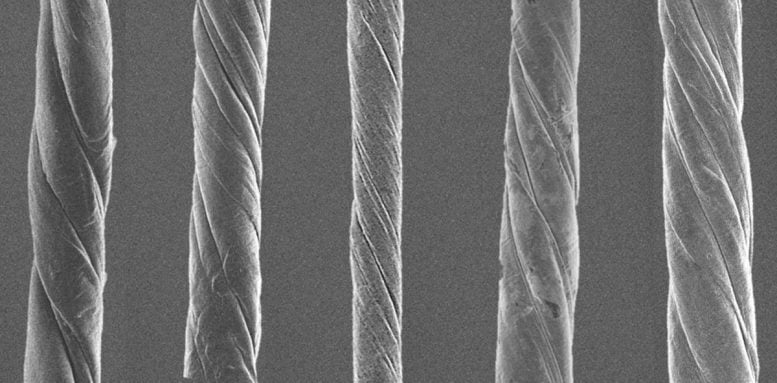
Researchers from the University of Maryland Baltimore County (UMBC), USA and their collaborators have discovered twisted carbon nanotubes (CNTs) can store three times the energy of lithium-ion batteries per unit mass. This research proves their use in lightweight, compact, and safe devices like medical implants and sensors.
The study was conducted by a global team, including Shigenori Utsumi, professor, Suwa University of Science, Katsumi Kaneko, professor, Shinshu University, and Sanjeev Kumar Ujjain, assistant research scientist, UMBC’s Center for Advanced Sensor Technology (CAST). Ujjain, who began this work at Shinshu University, collaborated with Preety Ahuja, assistant research scientist, CAST, who played a pivotal role in material characterisation.
CNTs, made from pure carbon sheets a single atom thick, exhibit remarkable properties. They are lightweight, 100 times stronger than steel, and relatively easy to manufacture. This makes them particularly appealing to industries prioritizing compact and durable energy solutions, such as healthcare for medical implants and consumer electronics for portable devices. The research team twisted single-walled nanotubes into “ropes” and treated them with various coatings to enhance their strength and flexibility.
Testing revealed these twisted ropes could store significantly more energy than traditional materials. “The best-performing ropes stored 15,000 times more energy per unit mass than steel springs,” the team noted, “and three times more than lithium-ion batteries.” Moreover, the energy remains stable at extreme temperatures, ranging from -76°F to +212°F.
Kumar Ujjain emphasised the safety advantages of CNTs over conventional batteries. “Humans have long stored energy in mechanical coil springs,” he said, adding that these nanotubes could serve as a revolutionary mechanical energy storage medium.
This innovation opens doors for diverse applications, from powering medical devices to advancing sensor technology. The CAST team is already working on a prototype sensor incorporating twisted nanotubes, hinting at a future where these remarkable structures redefine energy storage solutions.