




The stacking of graphene layers creates a material that can carry electricity without resistance and behave like a magnet at cold temperatures.
Credits:Image credit: Sampson Wilcox, Research Laboratory of Electronics
Graphite is made of layers of graphene—single-atom-thick, lattice-like sheets of carbon atoms—that are stacked and can easily flake off under pressure, such as when writing on paper. A single graphite flake can hold millions of graphene layers, usually aligned so every other layer matches. However, some regions have a different stacking pattern, forming a staircase-like structure. Researchers at MIT found that when four or five graphene layers are stacked in this “rhombohedral” way, the material shows unique electronic properties not found in regular graphite.
In their study, the physicists isolated flakes of rhombohedral graphene from graphite and ran electrical tests. They found that when the flakes are cooled to 300 millikelvins (about -273 degrees Celsius), the material becomes a superconductor, allowing electrical current to flow without resistance.
They also found that changing an external magnetic field up and down could switch the flakes between two superconducting states, similar to a magnet. This suggests the superconductor has internal magnetism. This switching is not found in other superconductors.
The researchers tested how this new superconducting state reacts to an external magnetic field. They applied a magnetic field and a voltage to the material and measured the resulting electrical current. As they varied the magnetic field from negative to positive polarity and back, they observed that the material stayed in its superconducting, zero-resistance state, except at two points—one at each magnetic polarity. At these points, the resistance briefly increased before dropping back to zero, and the material returned to its superconducting state.
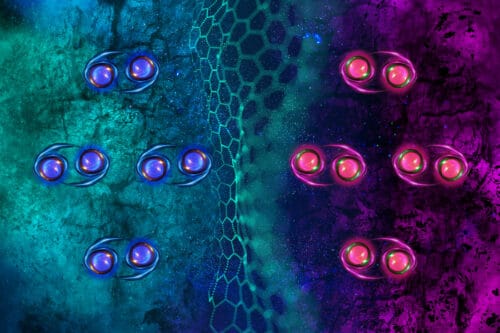
The researchers saw the same unusual behavior in six samples and believe it’s due to the special stacking of rhombohedral graphene. At very cold temperatures, electrons slow down and start interacting. These interactions make electrons pair up and move without resistance—this is superconductivity.
In this material, electrons all move in the same direction, or “valley,” so when they pair up, their motion doesn’t cancel out. This creates superconducting pairs with spin, which together can produce built-in magnetism.


