The new chip method uses light and electricity, helps move more data, saves energy, makes building easier, and supports stacking in layers.
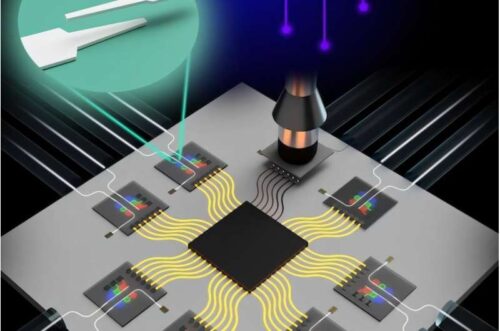
The future of computing and communication will combine electronics, which use electricity to process data, with photonics, which use light to transmit it—an approach that can handle more data while using less energy. To enable this shift, MIT’s FUTUR-IC team has developed a method for co-packaging electronic and photonic chips using a passive alignment process that works with standard equipment in electronics foundries. This removes the need for laser-based alignment, making the process more cost-efficient and suitable for production.
A key part of the method is a device called an evanescent coupler. Unlike couplers that require single-point alignment, this one has a longer interaction length. This increases alignment tolerance and allows robotic systems to assemble the chips without manual tuning. As a result, light loss is reduced and assembly becomes faster.
The coupler also supports vertical light transmission between chip layers, which was difficult because light does not easily change direction out of plane. This enables multi-layer chip designs.
These changes improve the function of electronic-photonic systems and support the rising demand in data communication. The packaging allows more connections, better energy use, and less signal loss—all needed for the rising number of connected devices and growing data load.
One possible way forward is to use electronics for processing and photonics for communication. Light-based transmission uses less energy than electrical signals, which makes it better for large-scale data systems.
But combining light and electronics in one system has been hard. Optical fibers must be aligned with photonic chips that are much smaller in cross-section. Any misalignment can scatter light, so each fiber needs laser testing—a slow and costly step.
The new packaging method from FUTUR-IC solves these problems and meets the system needs of future technologies.