Every step, car, and train creates energy we waste. A device captures these vibrations, adapts on its own, and powers devices without batteries.
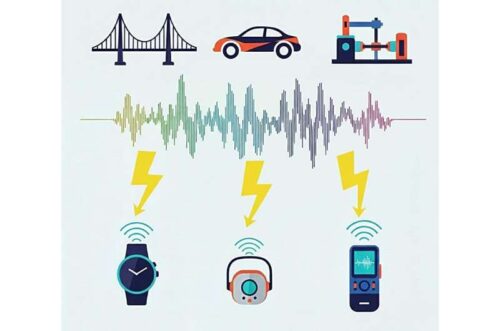
Every day, vibrations surround us as subways pass, bridges move under cars, and footsteps send small tremors through the earth, but this energy is usually wasted. Piezoelectric energy harvesters capture these vibrations and turn them into electricity to power devices. Traditional designs work like a diving board, with a thin beam that bends back and forth and material that generates electricity when stressed, but they only operate at one frequency, leaving much of the material unused.
Researchers at National Taiwan University developed a device that captures energy from vibrations. Its self-adjusting mechanism matches environmental frequencies, producing more power across a range of conditions.
The team asked what if the harvester could adapt itself? Their solution is a stretch-mode design where a PVDF film stretches evenly, making every part contribute to power generation.
The key feature is a sliding mass. It moves automatically, balancing inertia and gravity. When vibrations grow stronger, the mass slides outward, lowering the device’s natural frequency. As vibrations weaken, gravity pulls the mass back, raising the frequency. The device tunes itself like an instrument adjusting its own strings.
In lab tests, this self-tuning design made a difference. Compared to conventional harvesters, the device produced nearly twice as much power and worked across almost double the frequency range. In one test, it reached nearly 29 volts, a high figure for a device that fits in the palm of a hand.
It shifted smoothly between low and high energy states on its own, showing the self-adjusting system works in real conditions. Real-world vibrations change with traffic, weather, or time of day. A fixed harvester loses effectiveness, like a dancer who can’t keep tempo. A self-tuning harvester keeps adapting, generating power consistently.
The potential is large. Wireless sensors in buildings could power themselves for decades, portable devices could run without recharging, and medical implants could use body movement as energy. Every step toward self-powered technology reduces reliance on batteries.