




This allows multiple optical functions on a single chip, unlocking new possibilities for tunable light sources, optical computing, and quantum communication systems.
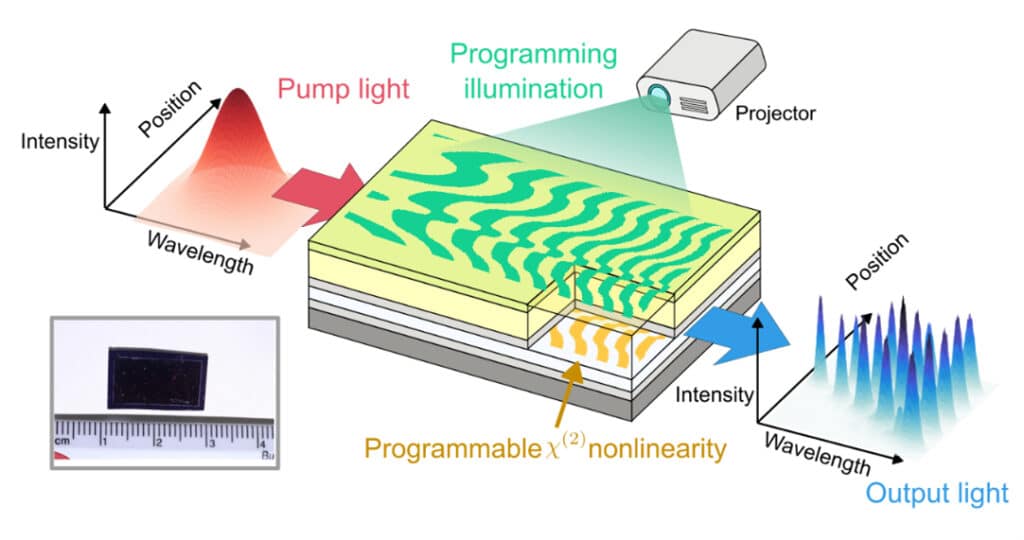
NTT Research, in collaboration with Cornell and Stanford University, has achieved a major milestone in photonics by developing the world’s first programmable nonlinear photonic chip, redefining how light-based devices operate. This advancement shatters the long-standing “one device, one function” limitation by enabling multiple nonlinear-optical functions on a single, reconfigurable chip—paving the way for advances in optical computing, quantum technologies, and next-generation communications.
Unlike conventional photonic components—each designed for a single task fixed during fabrication—the new waveguide uses a silicon nitride core whose optical nonlinearity can be dynamically tuned using structured light patterns. When a programming light is projected onto the chip, it alters how the device manipulates light, effectively allowing engineers to “rewrite” its function in real time. This allows a single chip to perform diverse optical tasks, including pulse shaping, second-harmonic generation, and holographic structured light creation, all while maintaining stability against fabrication errors or environmental drift.
The research, led by Ryotatsu Yanagimoto of NTT’s Physics and Informatics (PHI) Lab under Prof. Peter McMahon of Cornell, marks a significant step toward reconfigurable photonic systems capable of supporting both classical and quantum operations. Such flexibility could revolutionize quantum communication, data centers, and optical AI hardware, where rapid adaptation and compact designs are crucial.
A single programmable chip could replace multiple specialized components, cutting costs, improving manufacturing yields, and reducing energy and space requirements. According to IDTechEx, the photonic-integrated circuit market could exceed $50 billion by 2035, with applications spanning datacom, 5G/6G, quantum computing, sensors, and LiDAR.
Looking ahead, researchers envision expanding this technology to achieve programmable quantum nonlinearities, potentially enabling new architectures for quantum computation and communication. This work also opens pathways for integrating programmable nonlinearities into existing optical systems, unlocking hybrid functionalities.


