Radar can miss targets moving at similar speeds. Check out a method that can improve detection without extra hardware.
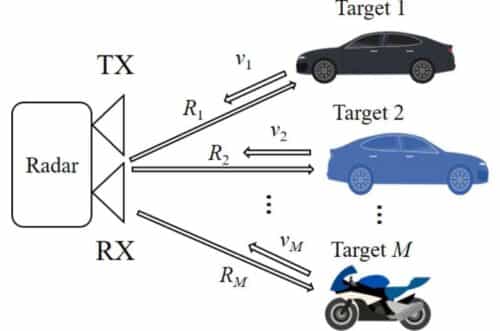
We all are familiar with the Radar systems. But do we know that the Radar systems often struggle to accurately detect and distinguish targets moving at similar speeds, especially when multiple objects are present. This limitation reduces the precision and increases target miss rates, creating challenges for UAVs, unmanned ships, autonomous vehicles, and other intelligent platforms that rely on high-resolution radar for safe and effective operation.
A research team from Daegu Gyeongbuk Institute of Science and Technology has developed a Doppler resolution enhancement algorithm for frequency modulated continuous wave (FMCW) radars to tackle this problem. The algorithm improves radar detection accuracy without requiring additional hardware or complex computations, making it suitable for real-time deployment.
Traditional radar systems rely on the fast Fourier transform (FFT) to measure target velocity, but FFT has limited resolution. To overcome this, the team applied a signal extrapolation technique, creating a new algorithm that enhances Doppler resolution without increasing observation time.
The method reduces the root mean square error in velocity estimation by up to 33% and lowers the target miss rate by up to 68%, offering clear improvements over conventional approaches. It maintains the same computational complexity as the standard FFT method, providing fast and efficient processing.
This approach specifically addresses signal overlap between targets moving at similar speeds, improving the ability to distinguish closely spaced objects. It represents a significant advance in high-resolution target detection for intelligent unmanned platforms. Its simple computational structure and hardware-free design make it practical for industrial and real-world applications.
Sang-dong Kim, principal researcher at the Division of Mobility Technology (concurrently serving the interdisciplinary engineering major), said, “This study demonstrates an improvement in both the efficiency and precision of radar signal processing, enabling more accurate target detection without the need for additional equipment. It is expected to evolve into a key technology for defense, autonomous driving, and unmanned systems.”