

Quantum computers are built on 300 mm wafers. Teams work together to make quantum chips and test them for the future.
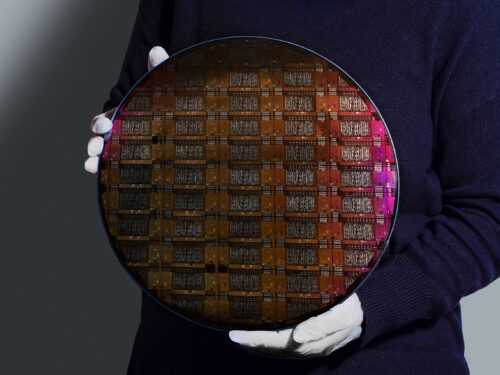
Scaling quantum computers requires treating quantum chips like leading-edge hardware. That means fabricating them to the highest quality standards comparable to those used for production-scale classical computer chips. IBM now reports that its IBM Quantum Loon and IBM Quantum Nighthawk chips, along with all future chips on the IBM Quantum Development Roadmap, are being made using advanced 300 mm semiconductor wafer technology.

IBM quantum processors are built from silicon wafers, much like classical computer chips. Long cylinders of silicon are sliced into thin disks, and engineers use computer software to design electrical circuits. Automated machines then etch, deposit metals, and treat the wafers, producing a grid of chips on each disk. Quantum chips undergo additional custom processing in Yorktown, where multiple chips are layered in a 3D stack and connected to control electronics. Both quantum and classical chips require extremely precise manufacturing and clean-room conditions, since even tiny particles can affect performance.
Quantum chip fabrication differs from classical chips in key ways. Qubits, the building blocks of quantum processors, are highly sensitive and interact in complex ways, requiring new materials, wiring, and assembly methods. The joint Albany-Yorktown team works in tight collaboration, iterating rapidly to design, process, and test chips, including Heron, Nighthawk, and Loon. Wafers are processed on 300 mm tools, sometimes reduced to 200 mm for custom steps, then assembled and tested in dilution refrigerators.
The 300 mm fab allows researchers to explore more designs faster, reducing cycle times and enabling rapid iteration. Success comes not just from the tools but from the tightly integrated team, combining expertise across semiconductor engineering and quantum physics. This collaboration has established IBM’s leadership in quantum computing and laid the foundation for future chips like Kookaburra, Cockatoo, Starling, and Blue Jay. The journey continues, with the team prepared to tackle the next generation of challenges.