





By eliminating current sensors without sacrificing efficiency, researchers have shown a new way to build smaller, cleaner, and more reliable AC/DC power converters pointing to slimmer chargers and simpler power electronics across consumer and industrial devices.
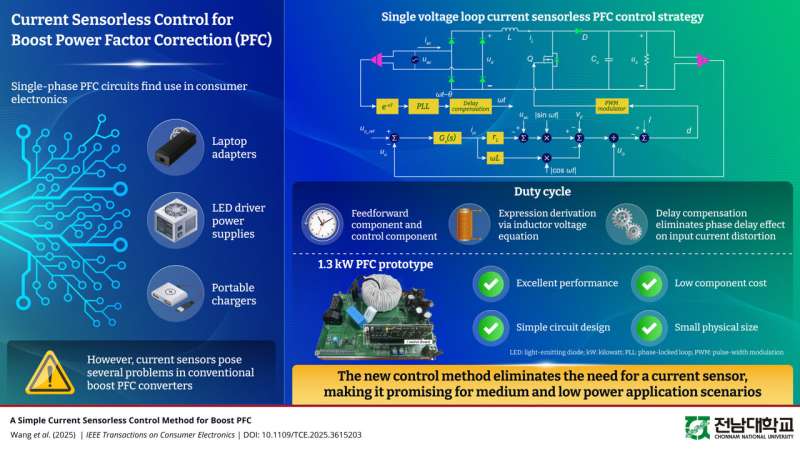
A research team has developed a sensorless power factor correction (PFC) method that promises near-unity efficiency while cutting size and complexity in AC/DC power adapters used across consumer and industrial electronics. The approach eliminates the need for traditional current sensors reducing noise, failure points, and overall hardware footprint in converters.
Modern single-phase PFC circuits, found in everything from laptop chargers to LED drivers, ensure that AC mains current stays in sync with voltage and that DC output remains stable. But they traditionally rely on current sensors that can introduce signal delays, noise susceptibility, and added circuit complexity issues that impact reliability and design cost.
Led by Professor Sung-Jun Park of Chonnam National University, researchers from South Korea and China have demonstrated a sensorless voltage-loop control strategy that sidesteps these limitations. Their technique derives the necessary duty-cycle control law directly from inductor voltage principles, augmented by phase-delay compensation to maintain clean input current waveforms. This enables power factors as high as 0.9998 and low total harmonic distortion (THD) even without current feedback sensors.
By removing the current sensor and avoiding complex observers or model-based estimation, the design reduces component count, lowers costs, and shrinks the overall converter size. It also improves noise immunity and reliability advantages that manufacturers can adopt readily using standard digital signal processors without extensive redesign.
The team validated the method on a 1.3 kW prototype, showing performance on par with or better than traditional sensor-based PFC converters. Beyond smaller adapters and chargers, the technology targets a broad range of AC/DC power supplies, potentially benefiting server power units, monitors, and industrial tools.
Looking ahead, widespread adoption could lead to lighter, more compact electronics, lower production costs, reduced electronic waste, and less stress on electrical grids due to cleaner current draw. Designers in both consumer and industrial segments stand to gain from simpler, more efficient front-end power stages.
