An Indian startup fights back with smart technology, protecting sensitive locations from increasingly stealthy drones with advanced detection and neutralisation.
By 2018, drones were changing fast. Once limited to student projects and event photography, drones could now fly higher and farther, operate quietly, and carry payloads. Small enough to fit into a backpack, they could cross fences and disappear within minutes, creating a new security risk for borders and sensitive locations. As drones became easier to operate and harder to detect, Himanshu Dave recognised the implications early—long before drone threats entered mainstream discussion in India.
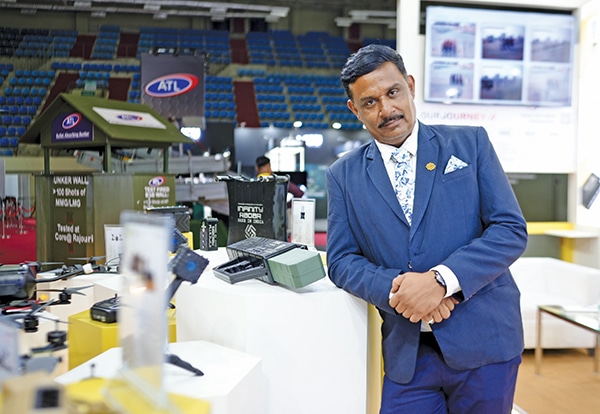
The Defence India Challenge later underscored the growing need for counter-drone technologies. When Himanshu’s idea was selected among the top ten participants in the government-led startup challenge, he realised that existing solutions were expensive and could be made more cost-effective. This insight led to the formation of Infitron Advanced Systems Private Limited in 2020, an Indian defence technology company operating under the brand infinityradar.com. The company focuses on advanced security and surveillance equipment, with a strong emphasis on counter-drone and command-and-control systems. The major clients are the Indian defence forces, as well as government bodies such as the Indian Army, the Coast Guard, and state police departments, including the Gujarat Police.
The company’s anti-drone technology is built on two layers: hardware and software. The hardware layer includes radar, RF detectors, and optical systems. Radars actively transmit signals and identify drones based on the small reflections returned. RF detectors passively monitor the three primary signals used by drones – controller, video, and GPS – to detect their presence. Optical cameras provide visual confirmation, ensuring that detected object is a drone rather than a bird or other airborne entity. Once identified, jammers can neutralise the drone by disrupting communication, forcing it into safe-landing or return-to-home mode without causing uncontrolled descent.
The software layer, known as the command-and-control (C2) system, integrates all hardware components into a single interface. It tracks and records drone activity, classifies threats using AI, and distinguishes between friendly and hostile drones. The system can alert operators or initiate automated responses to neutralise threats. According to Himanshu, integrating hardware-based detection with intelligent software enables comprehensive monitoring, tracking, and safe management of drone threats at sensitive locations.
As development progressed on a portable anti-drone system, several design challenges emerged. Weight proved to be the most significant constraint. Defence-grade materials such as aluminium made the system difficult to carry, while compact design requirements and heat dissipation added further complexity. Jammers generate substantial heat during operation, and managing this safely within a compact enclosure required careful engineering. “To solve this, we identified a special polymer material for the enclosure. This material reduced weight and also offered ballistic protection. The box itself became bulletproof, adding safety for the person carrying it. At the same time, it helped bring down the overall system weight,” explains Himanshu.
In a discussion about the startup’s current challenges, Himanshu disclosed that market demand is not the main challenge. The bigger challenge is technological. Drones are becoming more capable and powerful, which means anti-drone systems must continuously evolve to effectively detect and neutralise them.
Most of the technology development is done internally, but the company does use imported electronic components, such as semiconductors and power amplifiers, which are not yet manufactured in large quantities in India. “We are setting up our own manufacturing plant at Sanand, Ahmedabad, where our headquarter is located. Manufacturing is already underway at the same premises, and full-scale operations will begin once the necessary defence licences are obtained.”
The company also works closely with academicians and innovators who have unique ideas or technical capabilities. On talking about the ecosystem, Himanshu suggests, “In this sector, traditional distribution channels are not practical. We engage directly with our customers, as working through channel partners is not feasible for defence and security systems.”
Looking ahead, the startup plans to focus on R&D, prioritising technological innovation over traditional marketing, given the specialised nature of its defence solutions. Himanshu believes that the race between drones and counter-drone technologies is ongoing and will continue to shape defence strategies in the years to come.