






A device could change how breast cancer is found, enabling frequent screening at clinics and home, and helping detect tumors earlier than current methods.
For people at high risk of breast cancer, the main challenge is finding tumors early, before they grow or spread. Annual mammograms can miss cancers that appear between scans. These “interval cancers” make up 20 to 30 percent of all cases. More frequent screening could help, but current ultrasound systems are large, costly, and limited to hospitals and trained technicians. This reduces access, especially in rural areas, low-resource settings, and for people who need regular checks.
Researchers at MIT have built a small, low-cost ultrasound system to make frequent breast screening easier, in clinics and later at home. The aim is to give high-risk patients a way to monitor changes early, without repeated hospital visits.
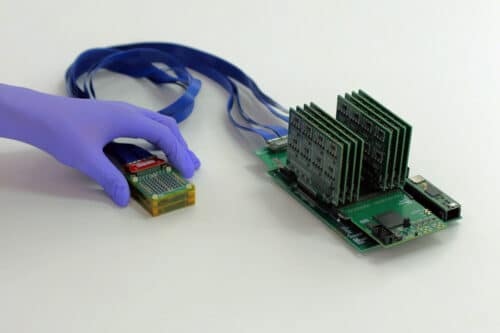
The system uses a compact ultrasound probe linked to a small processing unit slightly larger than a smartphone. When connected to a laptop, it produces wide-angle 3D images in real time. Unlike standard ultrasound, which often needs many scans and careful positioning, this system can capture the full breast in two or three scans, reducing gaps and effort.
This approach addresses two problems. First, it reduces the cost and size of ultrasound equipment. Second, it simplifies scanning, making it easier for clinicians, health workers, and later patients to use the device often.
The device also runs on low power, allowing it to operate from a small battery or standard adapter. This supports use in clinics with limited infrastructure, mobile screening units, and home settings.
In initial tests on a 71-year-old woman with a history of breast cysts, the system produced complete 3D images and identified the cysts. It can image tissue up to 15 centimeters deep and captures the full breast without pressing hard against the skin, reducing distortion and discomfort.
Larger clinical studies are in progress. The researchers are also working on shrinking the processing unit to fingernail size, so it can plug into a smartphone. Future versions may include an AI-based mobile app to guide users in placing the probe.
In the long term, the goal is a wearable ultrasound device that allows people at high risk of breast cancer to check regularly at home. By making frequent screening practical and affordable, the technology aims to detect tumors earlier, improve survival rates, and expand access to care beyond hospitals.


