


A tiny, fanless computer brings high speed and strong reliability for small machines. Can it help engineers build smarter systems in tight spaces?
Design engineers building compact industrial and mobile systems often struggle to balance performance, reliability, thermal limits, and space. High compute loads for motion control, vision processing, and AI inference usually demand bulky hardware, active cooling, and complex power designs. This adds size, noise, maintenance risk, and integration effort—especially in harsh or space-constrained environments such as factory floors, vehicles, robots, and kiosks.
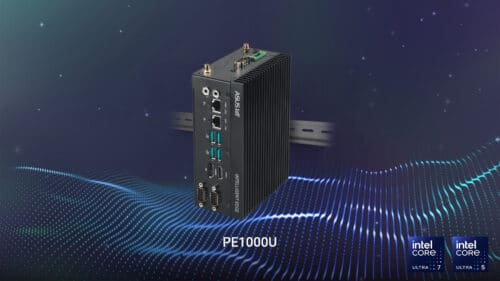
ASUS IoT has developed PE1000U, a compact, fanless edge computer designed for industrial and mobile deployments. Measuring just 63 × 110 × 160 mm, it delivers high computing performance in a sealed, rugged IP40 enclosure that operates reliably from -25°C to 70°C and withstands continuous vibration. Its wide 9–36V DC input and built-in ignition control simplify power design and enable direct on-vehicle deployment, while its small footprint supports tight installations in collaborative robots, AMRs, industrial vision systems, and other embedded platforms.
At the compute level, PE1000U uses Intel Core Ultra 265U or 235U processors with integrated CPU, GPU, and NPU acceleration. This allows real-time motion control, AI inference, and graphics workloads to run simultaneously without external accelerators, reducing system complexity and power overhead. Front-access I/O includes four USB ports, up to four COM ports, and up to four Ethernet ports, including dual 2.5G, enabling direct connection to cameras, sensors, PLCs, and networks. Dual CAN bus and isolated DIO support deterministic control, while DisplayPort and HDMI outputs drive up to two 4K displays for HMI and machine-vision monitoring.
Thermal reliability is achieved through a sealed, fanless design built around a wave-pattern aluminum heatsink that transfers heat directly from the CPU and memory to the enclosure. With no fans or vents, dust ingress is minimized and maintenance is reduced, enabling silent, stable operation in high-temperature and high-vibration environments. Passive cooling across the mainboard further improves long-term reliability, making the system suitable for continuous industrial operation.