Scientists have uncovered hidden superconducting behaviour inside diamond, opening a path to multifunctional quantum chips that combine computing, sensing and communications.
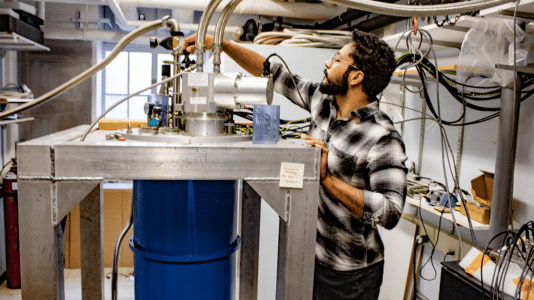
Researchers from the U.S. Department of Energy’s Argonne National Laboratory, Pennsylvania State University, and the University of Chicago have uncovered the physical mechanisms behind superconductivity in diamond, a discovery that could enable a new generation of multifunctional quantum chips.
Diamond is already valued in advanced technology for its thermal conductivity, optical properties, and durability. Under specific conditions, it can also become superconducting, allowing electricity to flow without resistance. Until now, however, scientists had limited understanding of how this behaviour emerged, restricting efforts to use it in practical quantum systems.
The study revealed that when diamond is doped with boron, it forms microscopic superconducting regions described as “puddles.” These regions eventually connect to create resistance free electrical pathways. Researchers found that this superconducting landscape can be manipulated through magnetic fields, electrical currents, and temperature, providing a potential route to engineer superconducting behaviour rather than simply observe it.
The findings could have significant implications for quantum hardware. Diamond already possesses a natural spin photon interface, allowing it to connect light based and matter based quantum systems. Combining this property with engineered superconductivity could enable multiple quantum functions, including sensing, communication, and computing, to coexist on a single chip.

The team believes that understanding and controlling these superconducting regions may also improve device performance and potentially reduce the extreme cooling requirements associated with many quantum technologies.
“We now have a reliable roadmap for engineering diamond superconductors by independently adjusting the material’s core properties,” says Nitin Samarth, Verne M. Willaman Professor of Physics and Materials Science and Engineering at Pennsylvania State University. “By tuning parameters like boron doping density, crystalline orientation, mechanical strain and dimensionality, we can move beyond simple observation and start designing diamond superconductors for specific roles.”