What if engineers could solve complex design problems in minutes instead of hours? An AI startup is building a system that uses physics-based AI to predict how design changes will perform in real-world conditions.

Artificial intelligence has transformed how people interact with language, images, and videos. Vinci believes the same transformation is now possible in the physical world. Founded in late 2023 in Palo Alto, California, by CEO Hardik Kabaria and CTO Sarah Osentoski, the company is developing what it calls a physics foundation model—an AI system that helps engineers predict product behaviour in real-world environments before manufacturing.
Vinci works much like ChatGPT, but for engineering design. Engineers can upload designs, define operating conditions—such as heat, force, stress, or mechanical loads—and receive near-instant predictions of how a product will perform under real-world conditions. The idea grew from the founders’ experience developing AI solutions for hardware engineering. While AI has reshaped many industries, hardware development still relies on validation and simulation processes that are often complex, costly, time-consuming, and dependent on specialised expertise. Vinci aims to make physics-based simulation faster, more affordable, and more accessible throughout the product development process.
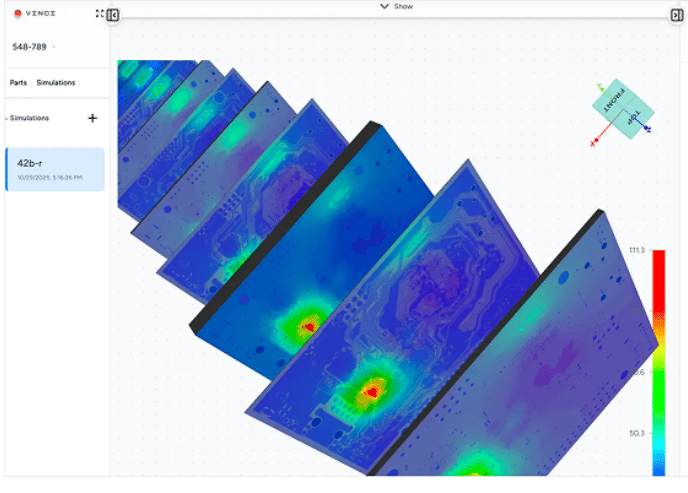
The company is a deep-tech startup that combines artificial intelligence, computational physics, and engineering simulation. Unlike most AI models that learn from large volumes of images or text, its foundation model learns the principles of physics. It uses geometries, materials, thermal and stress conditions, and other physical characteristics to train the model. The lack of publicly available engineering data has posed a unique challenge because suitable training data is difficult to obtain.
Building an AI engine capable of generating engineering-grade solutions presented significant technical challenges for the founders. One of the most critical requirements was accuracy. While language models can produce multiple acceptable answers, engineering problems typically have only one correct solution that complies with the laws of physics. Even minor geometric variations can result in substantial differences in thermal or mechanical behaviour, making simplification particularly difficult. During its first year, the team focused on developing a proprietary architecture capable of delivering highly deterministic and accurate predictions while preserving the speed advantages of AI. All development was carried out internally by the engineering team without relying on external design houses or independent engineering firms.
Today, the company employs around 60 people, primarily based in Palo Alto. Its multidisciplinary team brings together expertise in artificial intelligence, computational geometry, physics simulation, and hardware-aware software development. The decision to develop all technology in-house was based on the belief that breakthroughs in physics-based AI require close collaboration between AI research, computational modelling, and product engineering.
Another key innovation is its automated GPU-accelerated meshing technology, combined with native design ingestion capabilities that preserve manufacturing-resolution geometry. Meshing is a critical but traditionally time-consuming step in engineering simulations. The technology can automatically generate meshes for highly complex semiconductor designs, including GDS and OASIS data, with minimal manual intervention while reducing the need for extensive geometry preparation. Combined with AI inference engines, GPU-accelerated solvers, and workflow automation, this approach can deliver simulation speeds of up to 1,000× faster than conventional methods.
The company’s primary market is the semiconductor and electronics industry, where increasing chip complexity, higher power densities, and advanced packaging techniques create new thermal and mechanical challenges. The platform currently supports thermal analysis and thermo-mechanical simulations within EDA, PCB, and mechanical design workflows. Rather than replacing existing EDA tools, it is designed to add a physics-based intelligence layer to established engineering processes.
Building engineers’ trust in AI-generated results was also a top priority. To address this challenge, the platform provides residual norms and confidence metrics commonly used in simulation engineering. Prediction results can also be benchmarked against traditional finite element analysis tools and validated using customer-provided experimental data. These capabilities have helped build confidence among engineering professionals, who are often cautious about adopting new technologies.
Collaboration with academia has played an important role in the company’s development. It works with researchers such as Maziar Raissi, a co-creator of physics-informed neural networks (PINNs), as well as scientists from Stanford and UCSF. These partnerships contribute to advances in physics-informed AI and computational modelling while strengthening the scientific foundation of the technology. The company also expects to expand collaborations with semiconductor industry leaders.
Despite being a relatively young company, it has already established a presence in the semiconductor sector. Approximately 14 semiconductor companies are reported to be using the platform for stress analysis applications. Revenue and funding details have not been publicly disclosed. As a software-focused business, it does not manufacture physical products or operate manufacturing facilities. Instead, its strategy focuses on deploying enterprise software solutions.
Looking ahead, the company’s vision extends well beyond semiconductors. Having demonstrated that its physics-based reasoning model can address challenges ranging from advanced chip packaging to robotics, the technology is expected to find applications in robotics, machinery, mechanical engineering, and broader product design. The long-term goal is to make physics reasoning an integral part of the engineering workflow, enabling near-real-time simulation and optimisation. Achieving this vision will require continued collaboration with organisations tackling complex engineering challenges. The company believes the future of engineering lies in AI-powered physics reasoning, providing an intelligent layer for designing, validating, and optimising products more efficiently as engineering systems continue to grow in complexity.
| Company: Vinci Headquarters: Palo Alto, California, USA Year Established: 2023 Nature of Firm: Private technology startup Founders: Hardik Kabaria (CEO) and Sarah Osentoski (CTO) Employees: Approximately 60 Technology Focus: Physics AI and Engineering Simulation Customers: Around 14 semiconductor companies Revenue: Not disclosed Funding: Not disclosed Manufacturing Facilities: Not applicable (software company) |