




Manual soldering slowing your production line? This compact system delivers faster, repeatable joints and it can scale with your production.
Many electronics manufacturers still depend on manual piston soldering, a process that is slow, inconsistent, and difficult to scale. Quality often varies from operator to operator, new product setups take time, and small errors in motion or timing can lead to defects. As product complexity increases, these challenges turn into production bottlenecks, especially for small and mid-sized firms that can’t afford large automation teams.
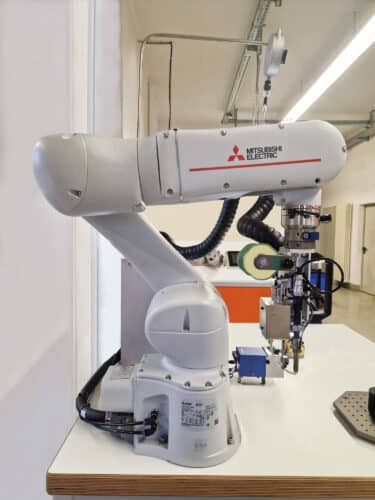
The Multiple Process Changer (MPC) soldering system is built to remove these bottlenecks. It automates piston soldering using a collaborative robot, turning a skill-dependent task into a stable, repeatable process. The entire workflow is coordinated through the EUTECT Machine Interface (EMI), which manages all robot and axis movements and lets operators define soldering paths, speeds, dwell times, and job data without advanced programming skills.
To ensure consistent solder joints, the soldering iron and wire feed sourced from JBC or Hakko are mounted directly on the robot arm so the system works as one integrated machine. This reduces variation and maintains uniform results across long production runs.
The setup also supports different production environments. It includes a rotary indexing table for manual loading, a safety cell, and an automatic tip holder for cleaning and tip changes. For higher volumes or automated lines, the indexing table can be replaced with a conveyor to enable inline operation and automated loading/unloading.
“We see the MPC automation platform as a flexible solution that can be equipped with different soldering processes for different AIT applications, depending on customer requirements,” says Fehrenbach, Managing Director of Eutect GmbH.
“At the trade fair, we will be showcasing the basic system, which can be customized to suit customer-specific processes. However, these customizations are carried out separately and are part of our special services,” explains Fehrenbach.


