

Metamaterial fabrics wirelessly power skin sensors to track blood pressure in real time, eliminating the need for batteries and enabling continuous health monitoring through everyday clothing—even during intense physical activity.
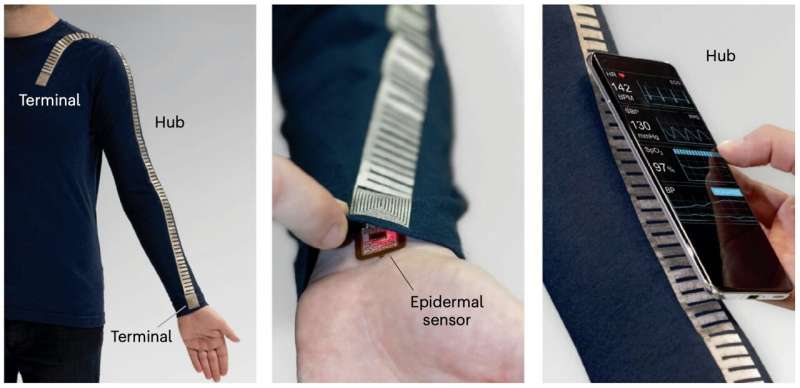
A new class of electronics-enabled textiles is turning everyday clothing into real-time health monitoring systems—without relying on batteries. Researchers from the National University of Singapore, the University of Arizona, and Tsinghua University have developed a battery-free wearable platform that continuously tracks systolic blood pressure using ultra-thin sensors embedded directly on the skin and interconnected through a smart textile. The system removes one of the biggest limitations of wearable electronics: the need for bulky, frequently recharged batteries.
At the core of the innovation is a metamaterial-based fabric that wirelessly transfers energy from a smartphone to the sensors. This textile serves as both a power-delivery network and a communication layer, enabling seamless operation without onboard energy storage.
The system uses multiple epidermal sensors—flexible, skin-like electronic patches—that capture physiological signals with high precision. Unlike conventional wearables, such as smartwatches, which often struggle with motion artefacts, the new setup maintains accuracy even during physical activity.
To ensure reliable performance, researchers separated power transfer and data communication into different frequency channels. This design reduces interference and enables stable, continuous monitoring in real-world conditions.

The implications for healthcare electronics are significant. Continuous blood pressure monitoring has traditionally required cuff-based systems or invasive methods, limiting usability outside clinical settings. By embedding sensing capabilities into clothing, the technology could enable long-term, real-world tracking for patients with cardiovascular conditions.
The development builds on the broader evolution of smart textiles—fabrics embedded with sensors and electronic components designed to monitor body signals in real time. However, most existing e-textiles still depend on integrated batteries, which add weight, reduce comfort, and require maintenance.
Early testing shows the system can deliver continuous, high-fidelity biosensing without external power packs, pointing toward more practical and scalable wearable health platforms. Researchers suggest future iterations could expand to track additional vitals, integrate with mobile health apps, and support personalised medicine.
As electronics continue to merge with materials science, battery-free wearable systems like this could redefine how health data is collected—shifting monitoring from devices we wear to the clothes we already use.