A new sensing solution combines RTK positioning and inertial tracking to deliver centimetre-level accuracy for robotics, drones, and field applications.
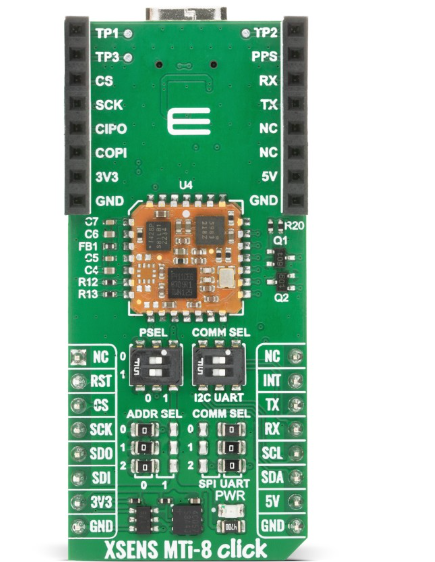
A new motion-sensing module from MIKROE, designed for embedded systems, delivers high-accuracy positioning and orientation tracking for applications such as robotics, autonomous vehicles, and precision agriculture. The solution integrates RTK-enabled GNSS with an inertial navigation system (INS), enabling reliable performance even in challenging outdoor environments.
At its core is the MTi-8-5A module, which combines satellite positioning with onboard sensors and real-time data fusion. This allows the system to maintain accurate tracking when GNSS signals are weak or temporarily unavailable, such as in urban canyons or partially obstructed areas.
The key features are:
- RTK-enabled GNSS with ~1 cm positioning accuracy
- Integrated INS with gyroscope, accelerometer, and magnetometer
- Up to 100 Hz data output for real-time tracking
- Multi-interface support: UART, SPI, I2C, USB Type-C
- Sensor fusion algorithms for stable navigation in GNSS-challenged environments
The module delivers position accuracy down to approximately 1 cm in RTK mode, making it suitable for applications requiring fine spatial precision. Orientation tracking is also tightly controlled, with roll and pitch accuracy of 0.5° RMS and yaw accuracy of 1° RMS when GNSS aiding is active. These capabilities support stable navigation and control in dynamic systems like drones and autonomous machinery.
Sensor data is processed using advanced fusion algorithms developed by Xsens that combine inputs from a gyroscope, accelerometer, and magnetometer. The system outputs data at rates up to 100 Hz, enabling responsive real-time operation for high-speed or continuously moving platforms.
Designed for flexibility, the module supports multiple communication interfaces, including UART, SPI, and I2C, as well as USB Type-C for configuration. It can also connect to external RTK-capable GNSS receivers, expanding deployment options across different system architectures.
The hardware is compatible with the MIKROE mikroBUS standard, simplifying integration into existing embedded designs. Additional features, such as automatic board identification and access to open-source software libraries, further reduce development time.
With the growing demand for accurate navigation in autonomous and field-based systems, this solution offers a compact, adaptable approach to integrating positioning and motion tracking on a single platform.