




A compact silicon PIN photodiode promises higher sensitivity and faster response for next-gen wearables and health monitors.
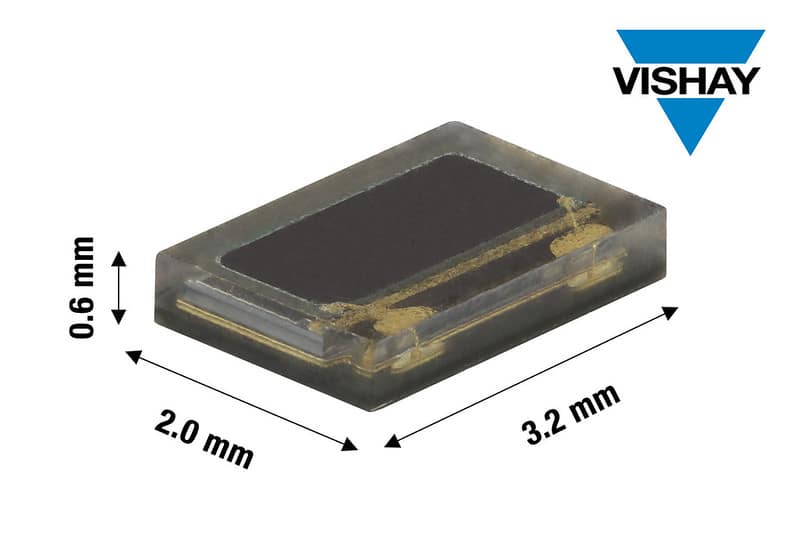
As health sensors continue to shrink while expectations rise, the latest silicon PIN photodiode from Vishay Intertechnology bridges the gap between compact size and high optical performance. The newly introduced VEMD8083 photodiode delivers enhanced sensitivity to visible and infrared light in a 3.2 mm × 2.0 mm × 0.6 mm surface-mount package, designed specifically for biomedical and wearable applications such as heart rate and blood oxygen monitoring.
The key features are:
- Package type: Surface-mount
- Package form: Top view
- Dimensions (L × W × H): 3.2 × 2.0 × 0.6 mm
It has large 2.8 mm² sensitive area, an impressive feat for its reduced footprint. Despite its smaller size, the VEMD8083 achieves high reverse light currents — up to 16 μA at 940 nm, 14 μA at 660 nm, and 11 μA at 525 nm — enabling stronger and cleaner signal capture under varying light conditions. This is particularly important for photoplethysmography (PPG) systems, where subtle changes in reflected light reveal critical information about blood flow and cardiovascular health.
Engineered for high-speed performance, the photodiode supports fast rise and fall times of 30 ns, paired with a low diode capacitance of 50 pF, making it well-suited for devices requiring rapid sampling and accurate timing. It also covers a wide spectral range from 350 nm to 1100 nm, detecting both visible and near-infrared radiation.
For developers, the diode maintains pin-to-pin compatibility with existing designs, simplifying system upgrades. Its ±60° angle of half-sensitivity ensures stable readings even when light angles fluctuate — a frequent challenge in wearable designs. Built for reliability, the photodiode operates from -40 °C to +85 °C, is RoHS-compliant, halogen-free, and meets Vishay Green standards. It also offers a moisture sensitivity level (MSL) of 3 in line with J-STD-020, supporting a 168-hour floor life for robust manufacturing processes.
With its balance of speed, sensitivity, and miniaturization, the new photodiode underscores how optical sensing continues to evolve — not just getting smaller, but smarter and more precise for the data-driven health tech era.


