




Researchers at Japan’s Chiba University have developed organic semiconductor devices that both emit light and harvest energy, potentially ushering in self-powered electronics and smarter energy-efficient displays.
Japanese scientists have smashed a long-standing materials barrier by creating organic semiconductor devices capable of simultaneous light emission and energy harvesting, a feat once thought nearly impossible due to conflicting physical requirements.

Organic semiconductors are already central to consumer tech like OLED displays and flexible photovoltaics, prized for their thinness and versatility. But combining both functions in a single component has been elusive because efficient light emission relies on excitons recombining tightly to produce photons, whereas efficient energy generation needs those excitons to dissociate quickly into free charges. This inherent trade-off has stymied multifunctional device designs.
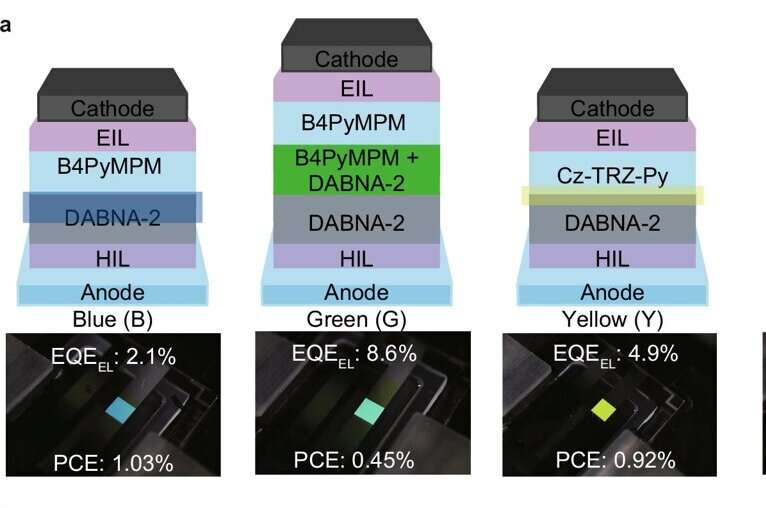
A research team led by Professor Hirohiko Fukagawa at Chiba University tackled this by precisely engineering the exciton binding energy (E₍b₎) within novel multiple-resonance thermally activated delayed fluorescence (MR-TADF) materials a class of compounds known for tunable photophysics. By optimizing donor/acceptor interfaces with very low E₍b₎, the group broke the traditional trade-off, enabling devices that both emit bright light and convert light into electrical power with significantly higher efficiencies than prior efforts.
Their multifunctional devices demonstrated light-emission efficiencies exceeding ~8.5% and power-conversion efficiencies around ~0.5%, a major leap over earlier prototypes that struggled to balance both metrics. Notably, the team also engineered the first globally reported blue OLED with integrated power generation, long a tough challenge in organic optoelectronics.
The breakthrough could pave the way for a new class of self-powered electronic devices where displays and lighting surfaces simultaneously harvest ambient light to reduce battery load. For example, consumer screens might capture indoor or outdoor light to extend battery life, and visible light communication systems could generate power during the day for operation at night.
Longer term, the technology points toward battery-less sensors, autonomous wearables, and integrated all-in-one films that combine multiple functions without separate components, supporting greener, more energy-efficient electronics. This work represents a shift toward multifunctional electronics where semiconductors are not just passive components but active energy partners in future devices.


