




A vacuum-based process could make solar cells faster and cheaper to produce while delivering efficiency on surfaces used in commercial panels.
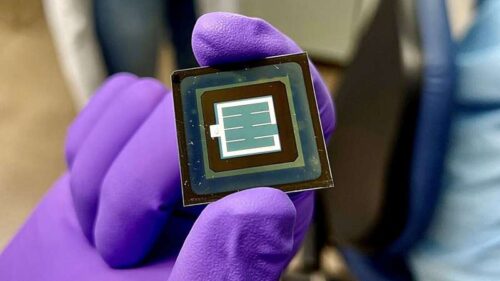
Researchers at Karlsruhe Institute of Technology and University of Valencia developed a vacuum-based method for manufacturing perovskite–silicon tandem solar cells, addressing barriers to scaling the technology for industrial production. The process, based on close-space sublimation (CSS), deposits perovskite layers on a range of silicon surface textures without using solvents, while maintaining device efficiencies.
Perovskite–silicon tandem cells are seen as a successor to silicon photovoltaics because they combine two semiconductors that absorb different parts of the solar spectrum. The perovskite top cell captures short-wavelength, high-energy light, while the silicon bottom cell absorbs longer wavelengths. This arrangement allows tandem devices to convert more sunlight into electricity than silicon cells alone.
The challenge has been manufacturing. Producing thin perovskite films quickly and consistently over large areas remains difficult, especially on textured silicon surfaces used in commercial photovoltaics to improve light absorption.
The researchers used CSS, a vacuum deposition technique in which precursor materials evaporate and travel a few millimeters before reacting on the silicon surface to form the perovskite layer. Unlike solution-based approaches, the process does not require solvents and uses small amounts of precursor material, which can also be reused.
A second focus of the study was tuning the band gap of the perovskite layer. In tandem cells, the top layer must absorb part of the solar spectrum while allowing the rest to pass through to the silicon cell beneath. Bromine is added to widen the band gap, but the researchers found that bromine introduced through inorganic precursor layers was not retained during perovskite formation.
To address this, the team used a mixed organic precursor source containing methylammonium iodide and methylammonium bromide. The researchers then tested the deposition process on smooth, nano-textured, and micro-textured silicon substrates. Textured surfaces are important in commercial solar cells because they increase the optical path of incoming light, improving absorption and efficiency.
The process produced comparable perovskite films across all three surface types without requiring changes to the deposition conditions. Microscopy and X-ray analysis showed coverage on each substrate.
The tandem cells reached efficiencies of 23.5% on smooth silicon, 23.7% on nano-structured silicon, and 24.3% on micro-structured silicon.

