





A guide explains how relays manage power and sensing in mining, covering voltage, conditions, and operation. Here is what engineers need to know.
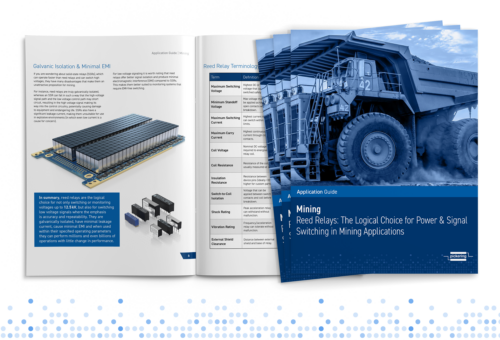
Pickering Electronics has released a new guide for engineers working on power and sensing systems in mining. The guide explains how reed relays can be used for both high- and low-voltage switching where stable operation and low power use are required.
Mining systems are becoming more electrified, which increases the load on switching, control, and monitoring circuits. Power must be managed across equipment such as conveyors, pumps, ventilation systems, and electric drills. At the same time, sensing systems must continue to give consistent readings in difficult conditions. The use of higher voltages is also increasing to reduce losses and improve system efficiency.
Because of this, relays used in mining need to handle higher electrical stress while still maintaining measurement accuracy and long-term reliability.
The guide outlines how reed relays fit these needs. It explains their use in power systems such as distribution units, switchgear, and load centres, as well as in signal-level applications like gas detection, airflow sensing, condition monitoring, and ground stability systems. In these use cases, relay performance directly affects both system operation and safety.
Reed relays combine power switching and signal handling in one device. This makes them suitable for systems that require both functions without adding complexity.
The guide also highlights key features of reed relays:
- Sealed construction to protect contacts from dust and moisture
- Ability to handle high switching and stand-off voltages
- Very low leakage for accurate sensing
- Electrical isolation to protect control circuits
- Fast operation and long service life
The document is intended to help engineers select relay technology for mining applications, based on system requirements for switching, monitoring, and control.
Pickering Electronics manufactures reed relays using instrumentation-grade switches designed for long operating life. Its designs include features such as coil structures without formers, mechanical support methods, and magnetic shielding to allow dense packing. Each relay is tested to maintain consistent performance across applications.
Click here for the application guide.

