Moving from demo floors to real-world duty to assist humans, India’s rising ‘robot dogs’ are gearing up to leave labs behind and stride into factories, harsh terrains and defence frontlines with power and purpose. But how?
Many critical tasks in industries and defence still require humans to operate in unsafe, repetitive, or physically demanding conditions. Inspections, monitoring, and logistics often occur in hazardous environments, including high temperatures, toxic atmospheres, uneven terrain, confined spaces, or conflict zones. Relying on humans in these situations increases the risk of injury, slows operations, and raises long-term costs.
Present monitoring and automation systems are mostly static. Fixed sensors and cameras can collect data, but cannot navigate complex environments or respond physically to issues, leaving humans to intervene even in urgent situations. Existing robots can be expensive, complex to customise, or ill-suited to real-world conditions, often failing in reliability, endurance, adaptability, or safety. As a result, their value is limited beyond demonstrations or in controlled environments.
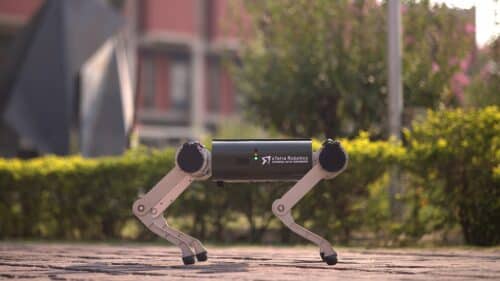
In an exclusive conversation, Aditya Pratap Singh Rajawat, co-founder and CEO of xTerra Robotics, explained how the deep-tech robotics startup is addressing these challenges by developing legged robots, particularly four-legged robot dogs and humanoid forms. The company is building its technology entirely from the ground up through a fully vertically integrated approach. This involves designing and manufacturing proprietary actuators for each robotic joint, developing in-house electronics, engineering the mechanical structure, and creating onboard intelligence that enables the robots to operate reliably across diverse and complex environments.
One of their products is the Svan M2, described as the first commercially available quadruped robot made in India. Weighing 11 kilograms, it can carry a 5 kilogram payload, giving it a notable payload-to-weight ratio for robots in this category. Its low weight, combined with high torque, makes it stand out among competitors in India and worldwide. Despite its light frame, it can carry a significant payload efficiently.
Interest from the defence sector is growing, but xTerra currently works mainly with industrial and research organisations. “Defence is a key target market for us, but at this point, the Indian Army is not our customer,” said Aditya. “We are, however, continuously engaging with different sections of the Army to understand their operational requirements and align our development accordingly.”
While Svan M2 targets research and industrial inspection, the company is now developing a heavier quadruped for defence logistics. The upcoming robot, expected around mid-year, is planned to weigh roughly 20 kilograms and carry payloads of 15 kilograms or more, with an eventual roadmap to 50-kilogram loads for high-altitude supply runs.
Over time, the company aims to not only sell robots but also provide services, mirroring how India’s drone industry evolved into drone-as-a-service. They want to build a robot-as-a-service ecosystem. If Svan M2 and its heavier successor can reliably perform tasks that humans cannot or should not do, India’s ‘robot dog’ story could quickly shift from pilot projects to frontline infrastructure and defence operations.
Full interview will be out soon!