




Flexible material switches conductivity 400× for next-gen electronics
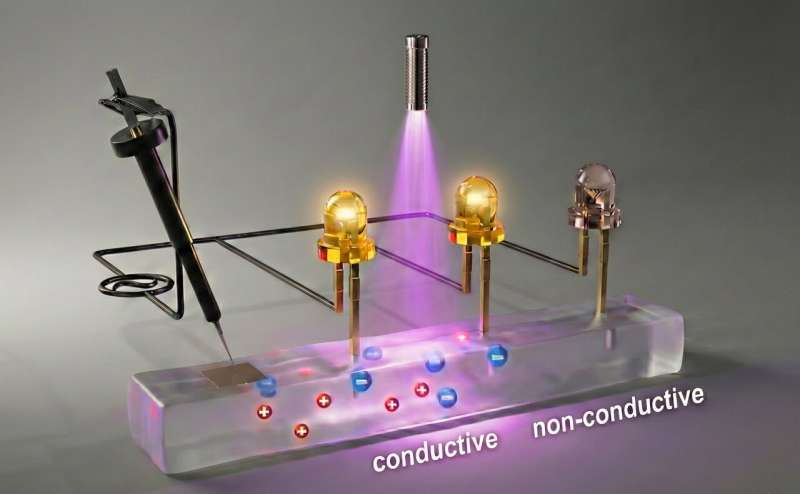
A newly developed soft electronic material could significantly advance ion-based devices, using light to dynamically control conductivity with unprecedented efficiency.
Engineers have created a flexible gel that increases ion conductivity by up to 400 times when exposed to light, enabling a rapid switch from insulating to highly conductive states.
The material integrates photo-ion generators within a stretchable gel matrix, allowing it to respond instantly to illumination. When activated, ions move far more freely through the structure, dramatically improving charge transport without requiring traditional electrical inputs.
This light-triggered behavior positions the gel as a key building block for ionotronic systems—electronics that rely on ion flow instead of electrons. Unlike rigid semiconductor components, the gel is soft and flexible, making it suitable for emerging applications where mechanical adaptability is critical.
Potential use cases span wearable electronics, soft robotics, and adaptive human-machine interfaces. Because the material can reversibly toggle between states, it opens the door to circuits that reconfigure in real time based on environmental stimuli such as light exposure.
From an electronics engineering perspective, the innovation reflects a broader shift toward hybrid materials that combine ionic transport with mechanical flexibility. Traditional ion-conducting systems—such as gels and ionogels—already offer advantages like high conductivity and structural stability, but typically lack dynamic control mechanisms.
By embedding optical responsiveness directly into the material, the new design eliminates the need for external control circuitry, reducing system complexity and power consumption. This could be particularly valuable in low-power edge devices and bio-integrated systems, where conventional electronics struggle with energy and form-factor constraints.
The breakthrough also complements parallel research into gel-based electronics, including materials that harvest body heat or improve battery safety, signaling a growing momentum around soft, multifunctional electronic platforms.
As development continues, researchers aim to expand the material’s responsiveness to multiple stimuli and improve durability, moving closer to practical deployment in next-generation adaptive electronics.

