By using a quantum sensor that measures an atom’s position and motion simultaneously, which seemed contradictory to the Heisenberg uncertainty principle.
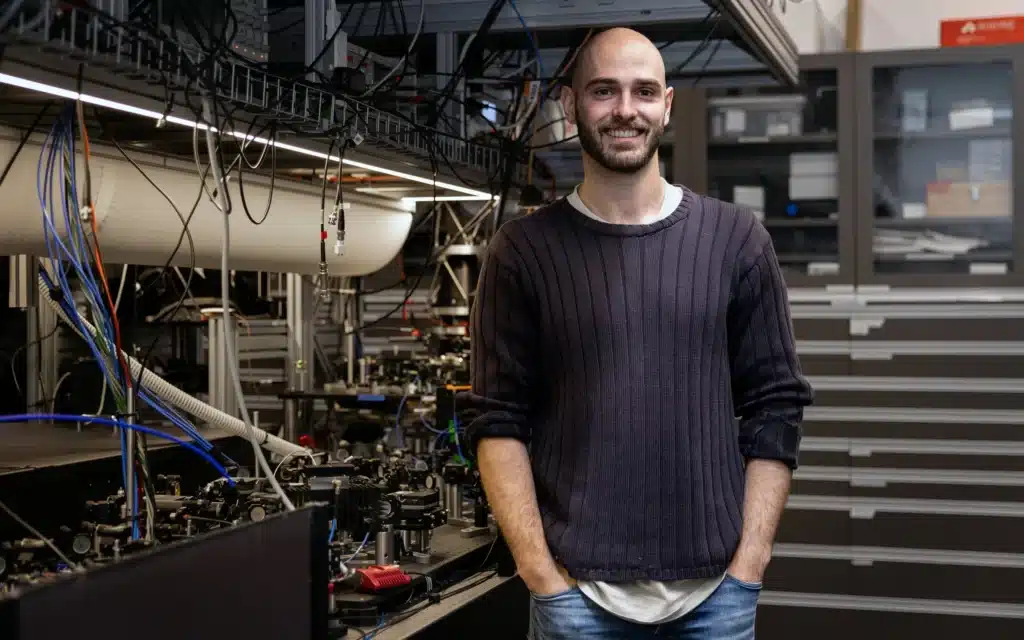
Researchers at the University of Sydney develops quantum sensor that measures both position and momentum with higher precision than previously possible using not light but a single atom. The experiment utilises a trapped ytterbium ion to surpass the measurement limits defined by the Heisenberg uncertainty principle, marking a significant step forward in quantum sensing.
The Heisenberg uncertainty principle defines that a particle’s position and momentum cannot both be measured with perfect accuracy. This constraint limits the sensitivity of quantum sensors, which rely on detecting small variations in atomic and molecular systems. The Sydney team overcomes this limitation by using a confined ion as a model system to measure both properties at once, improving accuracy within a limited sensing range.
The research applies a method known as quantum error correction, previously developed for quantum computing. The team generates specific vibration patterns, called grid states or Gottesman-Kitaev-Preskill (GKP) states, within the ion. These grid states allow the detection of subtle changes in both position and momentum simultaneously, exceeding the standard quantum limit achieved by classical sensors.
By controlling the ion with precise electric and magnetic fields, the researchers increase measurement accuracy at atomic scale while accepting reduced precision outside this range. The approach functions similarly to focusing a microscope, gaining clarity in a specific area while losing detail elsewhere.
The work adapts concepts from quantum computing for quantum sensing, showing how error correction methods can improve physical measurement systems. The technique could enhance spectroscopy, navigation in areas where GPS signals fail, and the search for dark matter. The findings expand how quantum systems can be used to measure fundamental properties of particles with high precision.