

Non-magnetic connectors reduce interference and improve signal quality in medical devices, wireless systems, computing equipment, and testing applications.
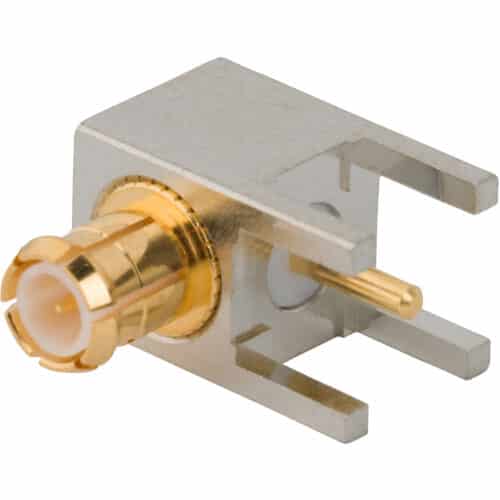
Amphenol RF has expanded its non-magnetic MCX connector lineup with new connector configurations designed for applications where magnetic interference can compromise system performance. By using non-ferrous materials and specialized plating, these connectors help preserve signal integrity in environments with strong magnetic fields while delivering the same electrical performance and reliability as standard MCX solutions.
The expanded range includes straight and right-angle plug and jack variants, available in both through-hole and surface-mount configurations. This broader selection gives design engineers and manufacturers more flexibility when integrating RF connectivity into compact or complex systems. Each connector is built with beryllium copper bodies and contacts and finished in either gold or white bronze plating, balancing conductivity, durability, and corrosion resistance. An “NM” marking on each unit helps assembly teams quickly identify non-magnetic parts and avoid installation mix-ups in systems using multiple connector types.
These connectors are aimed at engineers, OEMs, and system integrators working in industries where magnetic neutrality is essential. In medical imaging systems such as MRI system, they can support accurate signal transmission without contributing to image distortion. In quantum computing hardware, they help maintain signal stability while reducing the risk of magnetic interference affecting qubit operations. They are also suited for scientific instruments, test and measurement systems, and wireless communication modules where maintaining RF precision is critical.
The addition strengthens Amphenol RF’s wider portfolio of non-magnetic interconnect solutions, which already includes MMCX connector, SMB connector, SMP connector, and SMPM connector products. As more advanced systems operate in increasingly sensitive electromagnetic environments, non-magnetic RF interconnects are becoming a critical design requirement for reducing distortion, protecting electronics, and maintaining system accuracy.