The thin film senses heat without cooling systems. It could lead to smaller night-vision glasses and better sensors for uses in vehicles, space, and environment.
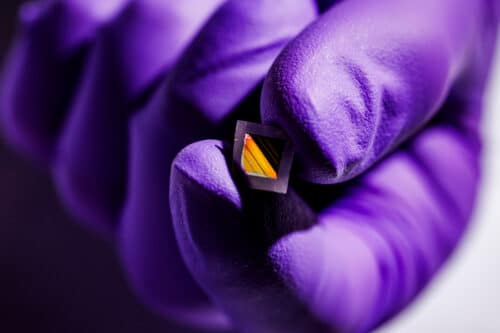
Credits:Photo: Adam Glanzman
MIT engineers have developed a method to grow and lift off thin “skins” of electronic materials. This method could lead to devices like transistors, sensors, and imaging systems. To show how it works, the team created a membrane from a pyroelectric material — a material that makes electric current when temperature changes. Thinner membranes are better at detecting temperature changes. Using this method, the researchers made a pyroelectric film 10 nanometers thick. They showed that it can detect heat and radiation across the far-infrared spectrum.
This film could lead to infrared sensors that don’t need cooling systems. That makes it useful for uses like night-vision eyewear and sensors for vehicles in poor visibility. The team is working on using the film in night-vision glasses. The film may also help with environmental and biological sensing, and with detecting signals from space. The lift-off method could also be used on other semiconducting materials. The researchers are exploring how to use the method for more types of electronics.
One method the team uses is “remote epitaxy,” where semiconductors are grown on a crystal base with a graphene layer in between. The crystal shapes the growth, and the graphene helps the film peel off and be reused. The team found that a material called PMN-PT can be peeled off without the graphene layer. This lets the film be removed and reused, which may help with other electronics.
In a new study, researchers found that PMN-PT is easy to peel off because it has lead. The lead atoms are arranged in a way that blocks electricity from moving to the base below, helping the film lift off without damage. The team used this idea to make thin PMN-PT films, 10 nanometers thick, and put them on chips to make 100 heat-sensing pixels. These pixels were good at sensing small temperature changes, even in the far-infrared range used in night-vision devices. The team thinks this peeling method could work for other materials by adding lead-like atoms to the base. They are now working on a full night-vision system using these films.