




A tiny device can control laser light very precisely while using much less power, making it possible to build bigger, faster, and more practical quantum computers.
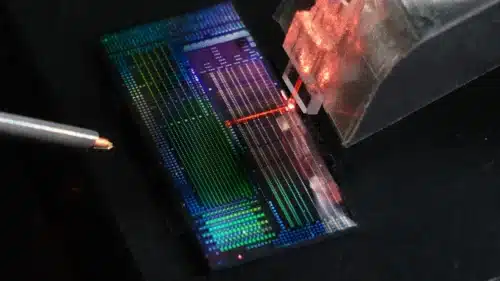
Quantum computing faces a major challenge. Controlling laser light with extreme precision for thousands or millions of qubits is difficult. Traditional setups rely on large, power-hungry table-top devices that are impractical for scaling. Researchers at the University of Colorado at Boulder have developed a device that solves this problem by manipulating laser light efficiently while using far less power, producing less heat, and allowing dense integration on a chip.
The device is a new type of optical phase modulator that uses microwave-frequency vibrations oscillating billions of times per second to control the phase of laser beams. This capability generates stable, efficient laser frequencies essential for quantum computing, quantum sensing, and quantum networking. It also reduces power use by roughly 80 times compared with conventional modulators, addressing the heat and space limitations of large-scale optical systems.
Unlike traditional optical modulators which are bulky, expensive, and hand-assembled, this device can be manufactured using scalable techniques similar to those used for computer processors, smartphones, vehicles, and household appliances. This makes mass production of thousands or millions of identical photonic devices practical.
The device is especially suited for quantum computing designs that use trapped ions or neutral atoms as qubits, which require lasers tuned with extreme precision sometimes to within billionths of a percent. By generating laser frequency shifts efficiently, the modulator allows multiple optical channels to operate closely together on a single chip, enabling the complex interactions needed for quantum calculations.
Researchers are now working on fully integrated photonic circuits that combine frequency generation, filtering, and pulse shaping on a single chip. The next step is testing these devices within advanced trapped-ion and trapped-neutral-atom quantum computers, moving closer to a scalable photonic platform capable of controlling very large numbers of qubits.


