




Designed for high-resolution in-vehicle cameras, it aims to shrink boards, simplify sequencing, and improve imaging stability in next-gen ADAS systems.
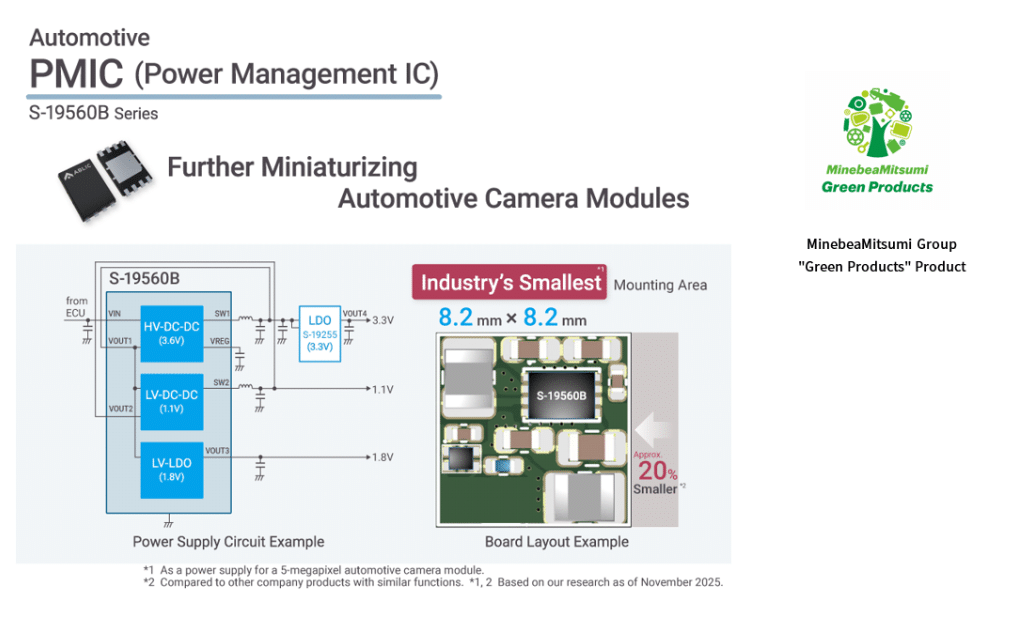
ABLIC Inc. has introduced its latest power-management integrated circuit, the S‑19560B Series, aimed at shrinking and improving thermal performance of automotive camera modules. Tthis new PMIC (Power Management IC) supports 16 V input and delivers three power outputs, making it one of the most space-efficient solutions available today.
At the heart of the series is an ultra-compact HSNT-8 (2030) package measuring just 2.0 × 3.0 × 0.5 mm a form factor that allows a much smaller footprint on camera modules. By combining two step-down (buck) DC-DC converter channels and one LDO (Low-Dropout) regulator channel in this single tiny package, ABLIC enables designers to implement a three-channel power supply in minimal board space.
The key features are:
- Ultra-compact 2.0 × 3.0 × 0.5 mm package
- Integrated dual DC-DC converters + one LDO
- Supports 4-channel power architecture
- Improved thermal distribution
- Noise-suppressed power delivery
Further footprint savings are possible when the S-19560B is paired with ABLIC’s own small, high-PSRR LDO regulator (the S‑19255). This arrangement enables a four-channel power supply solution with what ABLIC claims is the industry’s smallest mounting area for a 5-megapixel automotive camera module, roughly a 20% reduction in mounting area compared with competing 4-channel PMICs.
Beyond space savings, the design offers advantages in thermal management and noise suppression. Because one LDO can be placed externally from the PMIC, heat is dispersed more evenly, reducing localized heating inside compact camera modules, a critical benefit for in-vehicle camera systems. Shorter distances between the external LDO and the image sensor help suppress noise on the power line, which can otherwise degrade image quality.
On the system side, the S-19560B Series ships with output voltages, startup sequence and other key parameters preconfigured, so no further initialization is needed at power-on. That simplifies development for camera modules, especially useful when integrating with a variety of image sensors or serializers, each potentially having different voltage requirements or power-up sequences.
In terms of robustness, the PMIC’s specs are also targeted for automotive-grade use. It accepts an input voltage range from 4.0 V to 16 V; provides output-current capability up to 600 mA (DC-DC channel 1), 700 mA (DC-DC channel 2), and 300 mA (LDO channel); maintains output-voltage accuracy of ±1.5% across –40 °C to +125 °C; and supports protective features including overcurrent protection (1.2 A pulse-by-pulse), thermal shutdown (approx. 170 °C), short-circuit hiccup control, optional spread-spectrum clock, output discharge, undervoltage lockout, and compliance with lead-free / halogen-free requirements.
With the increasing proliferation of cameras in modern vehicles for rear-view, surround-view, driver monitoring, ADAS and autonomous-driving sensor suites demand for compact, efficient, and thermally reliable power solutions is rising. The S-19560B Series seems positioned to meet that demand, offering camera module designers a path to smaller, more efficient, and more easily designed power systems.


