The Resistivity Calculator allows use to easily calculate the resistivity of a component like a wire or coil, based on its resistance value, its length, and its cross-sectional area.
ρ = RA / L
×
![]()
The Resistivity Calculator is a handy tool for electronics engineers, physicists, and material scientists to determine the resistivity of various materials based on their physical dimensions and measured resistance. Resistivity is a fundamental property that indicates how strongly a material opposes the flow of electric current.
Understanding resistivity is crucial for designing efficient electrical circuits, selecting suitable materials, and optimizing electronic components.
Why Use This Calculator?
The Resistivity Calculator offers several key features:
- Accurate and Quick Results: Provides precise resistivity values, helping to eliminate guesswork in material selection.
- User-Friendly Interface: Simple inputs for material dimensions and resistance make it easy to use, even for beginners.
- Versatile Application: Suitable for a wide range of materials, including metals, semiconductors, and insulators.
- Educational Resource: Helps students and researchers understand the relationship between material properties and electrical resistance.
- Free and Accessible: Available online without any cost, making it an ideal tool for both professionals and hobbyists.
How to Use the Resistivity Calculator
Follow these steps to use the calculator:
- Input the Measured Resistance: Enter the resistance of the material in ohms (Ω).
- Input the Length of the Material: Specify the length of the material in meters (m).
- Input the Cross-Sectional Area: Enter the cross-sectional area of the material in square meters (m²).
- Click Calculate: The tool will instantly display the resistivity of the material in ohm-meters (Ω⋅m).
Formula:
The resistivity (ρ) of a material is calculated using the formula:
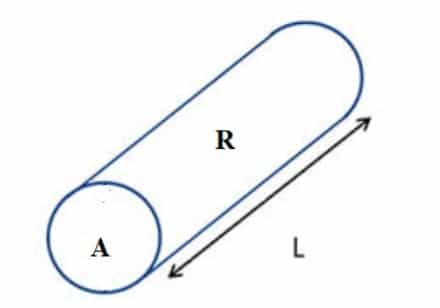
ρ=R×(A/L)
Where:
- ρ is the resistivity (in ohm-meters, Ω⋅m),
- R is the measured resistance (in ohms, Ω),
- A is the cross-sectional area of the material (in square meters, m²),
- L is the length of the material (in meters, m).
Applications of the Resistivity Calculator
The Resistivity Calculator is useful in various scenarios:
- Material Science: Helps in characterizing the electrical properties of different materials, aiding in research and development.
- Electronics Design: Assists in selecting materials for resistors, wires, and other components based on their resistivity.
- Quality Control: Provides a quick way to verify the resistivity of materials during manufacturing and ensure they meet specified standards.
- Educational Use: Aids students in understanding the relationship between resistance, resistivity, and material dimensions.
Loading form…