




India’s autonomous future will not arrive overnight, and it will not look like anyone else’s. But step by step, through semi-autonomy, smart policy, and local innovation, AI can make Indian roads safer while still keeping humans firmly in the driver’s seat.
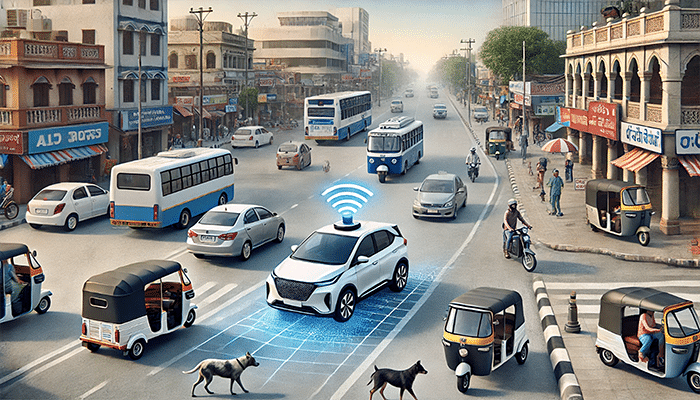
(Image created by the author using OpenAI DALL·E)
Artificial intelligence (AI) has evolved from its early role in mobile robot navigation to the advanced technologies that underpin fully autonomous vehicles. In India, this evolution extends beyond technological curiosity to directly address road safety, traffic congestion, and energy sustainability within one of the world’s most complex transport ecosystems.
From mobile robots to driverless cars: The evolution of AI
The story of AI’s journey from enabling mobile robots to powering autonomous vehicles is one of relentless innovation. Early mobile robots relied on basic sensors and algorithms to navigate controlled environments such as factories and warehouses. These systems followed predefined paths while avoiding obstacles. However, their limited ability to adapt to dynamic settings exposed the need for more advanced AI-driven approaches.
As deep learning and computer vision matured, AI has enabled machines to operate in unstructured environments. These developments laid the foundation for autonomous vehicles, where AI systems function at significantly higher levels of complexity. Modern driverless cars use convolutional neural networks (CNNs) and advanced machine learning models to identify objects, predict behaviour, and make split-second decisions. In parallel, advances in sensor fusion have improved how autonomous systems integrate inputs from lidar, cameras, and radar, enabling them to build a more comprehensive understanding of their surroundings.
India’s road conditions pose distinct challenges for these technologies. Road environments vary widely, from well-paved highways to congested urban streets shared by pedestrians, cyclists, and stray animals. Autonomous systems must therefore cope with highly unstructured and unpredictable conditions. In addition, seasonal weather patterns, particularly monsoons that reduce visibility and lead to waterlogged roads, further complicate autonomous navigation across the country.
Also read: Writing The Rules For Autonomous Vehicles.
The Indian roadscape: A stress test for AI
Compared with the relatively organised traffic conditions found in many developed nations, Indian roads represent a significant stress test for AI. Lane discipline is often inconsistent, road quality varies significantly, and unexpected elements, such as cows, stray dogs, or roadside vendors, can appear at any time. Seasonal extremes, including monsoon-driven flooding and poor visibility, add to the difficulty, making India one of the most challenging environments for autonomous driving.
As a result, AI systems deployed in India cannot simply replicate solutions developed elsewhere. They must be localised, trained on Indian datasets, and designed to respond to highly unpredictable human and environmental behaviour.
The role of AI models and edge computing
AI forms the backbone of autonomous navigation, enabling vehicles to process large volumes of sensory data in real time. In India, where road infrastructure remains inconsistent, edge AI plays a critical role. Deep learning algorithms are central to recognising and responding to complex traffic scenarios, including the ability to distinguish between pedestrians, street vendors, and stray animals.
The capacity of AI systems to learn continuously and adapt to local conditions is essential for safe and efficient autonomous driving. Reinforcement learning models, which allow systems to improve through trial and error, are being explored to address the unpredictability of Indian traffic patterns. Running AI models on embedded edge devices such as smartphones, Jetson modules, or vehicle electronic control units (ECUs) reduces reliance on cloud connectivity and enables instant decision-making, even in areas with limited network coverage.
Also read: Establishing Ethical Framework for Autonomous Vehicles
Connectivity, 5G, and V2X ecosystems
The next major advance is expected to come from vehicle-to-everything (V2X) communication, which enables vehicles to communicate with one another, traffic signals, and pedestrians. On Indian roads, V2X has the potential to improve traffic coordination by supporting real-time alerts related to congestion, accidents, and roadblocks.
In densely populated urban environments characterised by unpredictable behaviour, V2X technologies could play a key role in improving traffic flow. Vehicles equipped with V2X systems can receive timely information about incidents or disruptions and adjust routes accordingly. Integration with smart city infrastructure may further enhance coordination between traffic signals, public transport systems, and emergency response services.
Startups such as Vehiqilla are already developing secure V2X platforms to strengthen vehicles’ environment communication. However, widespread adoption will require substantial upgrades to road infrastructure, including consistent lane markings, reliable real-time data systems, and intelligent traffic management frameworks. Cybersecurity also remains a critical concern, as V2X systems must safeguard data integrity and prevent malicious interference.
With the rollout of 5G networks across India, ultra-low-latency communication is expected to significantly enhance the reliability of V2X systems. A tightly connected ecosystem, linking autonomous buses, emergency vehicles, and traffic signals, could help reduce congestion while improving overall road safety.
Overcoming public perception and regulatory barriers
Public perception remains a significant barrier to the adoption of autonomous vehicles in India. Many Indians are sceptical about the safety and reliability of driverless cars, while concerns about job losses in the transport sector add to this hesitation. Building trust through education, transparent trials, and demonstration projects will be critical, particularly if these efforts clearly demonstrate how autonomous systems can reduce accidents and save lives.
On the regulatory front, India’s legal framework for autonomous vehicles is still in its infancy. While the government has expressed interest in promoting electric and autonomous vehicles as part of smart city initiatives, comprehensive policies addressing safety, liability, and ethical considerations remain necessary to support widespread adoption. Regulations that ensure robust testing standards and clear certification processes will play a pivotal role in creating a reliable and trusted ecosystem for autonomous driving.
Indian ecosystem: Startups, industry, and policy
The autonomous ecosystem in India is gaining steady momentum, driven by a combination of homegrown startups, established automotive manufacturers, and a deep IT talent base. Rather than pursuing a single moonshot, progress is emerging through tightly scoped deployments in industrial corridors, ports, campuses, and logistics hubs, where autonomy can demonstrate safety and return on investment early.
Among startups, Bengaluru-based Minus Zero is developing an end-to-end ADAS and autonomous driving stack tailored to India’s unstructured traffic conditions and cost constraints. Ati Motors, meanwhile, focuses on rugged autonomous mobile robots designed for use in factories and warehouses.
RoshAi, a Kochi-based startup, is entering the space with a full-stack autonomy approach for both on-road and off-road applications. Its portfolio includes a modular, retrofit-ready Level-4 autonomy stack for trucks, buses, and passenger cars; a 5G-enabled fleet management platform for real-time tracking and predictive maintenance; and a General Perception Intelligence (GPI) framework that fuses vision, lidar, radar, and polarised light into a machine learning pipeline for detection and decision-making. RoshAi positions its offering as a vehicle- and sensor-agnostic autonomy operating system, supported by leadership with extensive experience in robotics and autonomous mobility on Indian roads.
Established automakers are advancing in parallel. Tata Motors, Mahindra, and Ashok Leyland continue to trial semi-autonomous and autonomous capabilities within controlled operational design domains such as mines, ports, and industrial campuses. Partnerships are also emerging. For example, Ashok Leyland’s collaboration with Minus Zero on self-driving trucks for industrial settings signals a pragmatic, application-first route to autonomy in India.
India’s IT majors, Infosys, TCS, and Wipro, serve as bridges between global original equipment manufacturers and Tier-1 suppliers and domestic pilot programmes. Their strengths in software platforms, validation and simulation, cybersecurity, and lifecycle support help adapt mature technologies to India’s traffic realities and cost structures.
On the policy front, NITI Aayog’s National Strategy for AI identifies mobility as a priority, while the Smart Cities Mission and broader electric vehicle incentives create favourable conditions for pilot projects. What matters next is the critical foundational infrastructure: clear testing standards and certification pathways, sandboxed trials, high-quality datasets, and high-definition map layers. Data-sharing frameworks with strong privacy safeguards are also required. Finally, incremental investment in connected infrastructure, reliable lane markings, calibrated signals, and V2X-ready corridors will be essential to enable autonomy to scale safely.
Safety, society, and regulation
India accounts for nearly 11% of global road fatalities while owning only around 1% of the world’s vehicles. This disparity underscores the urgent need for safer mobility solutions. Autonomous and semi-autonomous systems have the potential to reduce this toll through features such as lane-keeping assistance, automatic emergency braking, drowsiness detection, adaptive cruise control, and collision avoidance. These technologies could not only save lives but also reduce the economic burden of accidents, which currently costs India an estimated 3-5% of its GDP each year.
At the same time, public perception remains a formidable barrier. For many drivers, ceding control to an AI-driven system raises concerns about trust and safety. Fears around job displacement, particularly among truck, taxi, and delivery drivers, further complicate acceptance.
However, this disruption is double-edged. As the ecosystem matures, new roles are expected to emerge in areas such as AI model training, sensor calibration, simulation environments, fleet monitoring, cybersecurity, and real-time remote support for autonomous fleets. For India’s large pool of engineers and technicians, this shift presents an opportunity to reskill and participate in the future of mobility.
On the regulatory front, India still lacks a comprehensive framework for autonomous vehicles, although early steps are underway. NITI Aayog has emphasised mobility in its National Strategy on AI, and several state-level authorities have begun exploring controlled pilot deployments. Transparent trials in industrial campuses, ports, mines, and smart city corridors can act as stepping stones before broader public deployment. At the national level, policies must address safety certification, liability in the event of accidents, data privacy, and ethical considerations.
Ultimately, regulation must strike a careful balance between encouraging innovation and safeguarding lives and livelihoods. If India establishes robust standards and early pilot frameworks, it can accelerate domestic adoption and position itself as a global hub for affordable, safety-first autonomous solutions.
Also Read: Autonomous Vehicle Safety Adversities and Confronting Techniques.
The road ahead: Semi-autonomy first
For India, the near-term future lies in semi-autonomous systems, driver-assistance technologies that enhance human capability rather than replace drivers entirely. These systems can act as a transitional bridge, reducing accidents and improving efficiency while preparing society for eventual full autonomy. Over the longer term, the convergence of electric vehicles, artificial intelligence, and shared mobility points towards cleaner, safer, and more efficient transport in a country that adds millions of new vehicles each year.
The evolution of driverless vehicles is reshaping transportation worldwide, but India’s path will be distinct. Semi-autonomous systems that support human drivers are likely to take centre stage, serving as a practical bridge towards fully autonomous mobility. Equipped with AI-driven features, these systems can improve safety, reduce accidents, and optimise traffic flow.
AI-powered transportation has the potential to transform mobility in India. With sustained innovation, collaboration across industry and policy, and a clear focus on local challenges, autonomous vehicles could redefine how the country moves, making roads safer, cities smarter, and commutes more efficient. While the road ahead is undoubtedly challenging, it also offers substantial opportunities, pointing to a future in which technology and human intelligence come together to reshape transportation in one of the world’s most dynamic environments.
Vishnukumar V. is a researcher at the Position Navigation and Timing Laboratory (PNT Lab), Department of Instrumentation, Cochin University of Science and Technology (CUSAT), Kochi, Kerala


