Hydrogen leaks are hard to detect in humid air, but a new sensor gets more accurate as moisture rises. Could this change safety in energy and transport?
Wherever hydrogen is used, safety sensors are needed to detect leaks and stop the formation of hydrogen–air mixtures that can catch fire. However, most existing sensors do not work well in humid conditions. This is a problem because hydrogen is often present where humidity is high. Researchers at Chalmers University of Technology, Sweden, have developed a sensor for humid environments. Unlike current sensors, it becomes more accurate as humidity increases.
The performance of hydrogen gas sensors can change depending on the environment, with humidity being a key factor. Many sensors become slower and less accurate in humid conditions. Tests of a new sensor concept showed that increasing humidity improved its response to hydrogen. This behavior led researchers to study the mechanism in detail.
Hydrogen is becoming an energy carrier, especially in transportation, chemical processing, and steel production. Water is present in air and is also produced when hydrogen reacts with oxygen, such as in fuel cells used in vehicles and ships. Fuel cells also require moisture to prevent internal membranes from drying. In addition, hydrogen production and storage facilities are exposed to air, where humidity can vary with temperature and weather. This makes humidity-tolerant hydrogen sensors essential for safety.
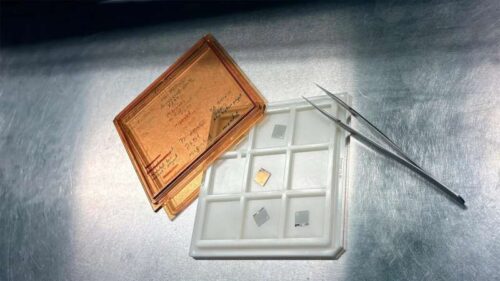
The hydrogen sensor is fingertip-sized and uses platinum nanoparticles that act as catalysts and sensing elements and speed up the reaction between hydrogen and oxygen, producing heat that causes the water layer on the sensor surface to evaporate. The amount of hydrogen controls how much water evaporates, while humidity controls how thick the water layer becomes, and by measuring changes in this water layer, the hydrogen concentration can be detected, with higher humidity improving sensor performance. A light-based effect allows the platinum nanoparticles to change color as hydrogen levels change and triggers an alarm at certain concentrations.
Research on plasmonic hydrogen sensors has improved speed, accuracy, and performance in humid air. Older designs used palladium particles, while the new design uses platinum for humidity. Long tests showed operation for over 140 hours and detection down to 30 parts per million. As hydrogen use grows, there is demand for sensors that are small, flexible, low-cost, and easy to scale. This sensor meets these needs, and future work will combine materials to ensure performance in all environments.