





This infrared bug circuit can be used to detect the presence of modulated infrared signals in its vicinity from any electronic source, for instance, an IR handheld remote controller. It can also be used for testing IR burglar alarm systems.
Infrared Bug Circuit
Fig. 1 shows the circuit of the infrared bug. Besides the power supply(one 9V PP3/6F22 compact battery pack), it consists of an infrared signal detector cum pre-amplifier followed by a melody generator and a tiny audio amplifier. The circuit, in principle, converts the IR signal pulse trains into noticeable aural notes.
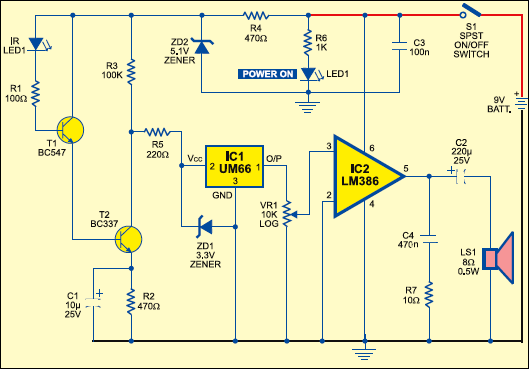
S1 is used to switch on /off mains power and LED1 indicates power- ‘on.’ Resistor R4 and zener diode ZD2 form a low-current voltage stabilizer for providing steady 5.1V DC to the small signal pre-amplifier circuit. IR LED1 is the main sensing element. The IR signal detected by IR LED1 is amplified by npn transistors T1 and T2. The amplified signal is fed to the melody generator via resistor R5. The output of the melody generator is fed to LM386 low-power audio amplifier(IC2) via variable resistor VR1, which works as the volume control. The loudspeaker sounds to indicate the presence of IR signal near the circuit.
IC LM386 is wired as a minimum-parts amplifier with a voltage gain of ‘20,’ which is sufficient for this application. Capacitor C3 is used for decoupling of the positive rail and the R-C combination network comprising C4 and R7 by passes high frequency to ground.
Construction & testing
The circuit can be easily wired on a small veroboard or any general-purpose PCB. Pin configurations of IC LM386, transistor BC547 and melody generator UM66 are shown in Fig. 2. A miniature metallic cabinet may be used for enclosing the gadget.

The article was first published in March 2006 and has recently been updated.

Sir, IR LED1 is a emitter LED or IR receiver? The arrows of IR LED1 is outward and denote IR LED.
Dear Sir,
IR LED1 is receiver LED.
The arrows of IR LED1 should be reversed.
Thanks