Researchers at Wuhan University have developed new, more effective memristors using special metallic materials.
The growing use of AI-based models is increasing demands on the electronics industry for more storage and computational power. Engineers are responding by developing neuromorphic computing systems that often utilize memristors, components that regulate electrical currents and remember past charges, similar to brain synapses. This could improve machine learning efficiency. However, many memristors face limitations like small on/off ratios, which reduce their ability to accurately represent weights, increasing noise and decreasing prediction accuracy.
Researchers at Wuhan University have developed new memristors with analog switching and high on/off ratios, using two-dimensional (2D) van der Waals metallic materials as cathodes. The team emphasized the utility of analog memristors with multiple conductance states for high-efficiency neuromorphic computing, which are often constrained by limited weight mapping capabilities due to small on/off ratios.
The team demonstrated that memristors with analog resistive switching and significant on/off ratios can be constructed using van der Waals metallic materials such as graphene or platinum ditelluride for the cathodes, employing silver as the top anode and indium phosphorus sulfide as the switching medium. Their unique memristor design incorporates an exceptionally high diffusion barrier that restricts the migration of silver ions, enabling both analog switching and on/off ratios comparable to those seen in digital memristors.
The team leverages the van der Waals cathode to facilitate silver ion intercalation and deintercalation, thereby creating a high diffusion barrier to modulate ion motion effectively. This strategy allows for analog resistive switching with an on/off ratio up to 10^8, supporting over 8-bit conductance states and achieving attojoule-level power consumption.
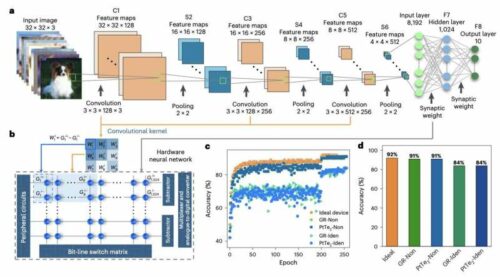
To test their memristors, the researchers conducted a chip-level simulation of a convolutional neural network (CNN) for image recognition. The results were highly promising, with the model achieving image recognition accuracies of up to 91%.
Looking ahead, the team plans to further enhance their newly developed memristor and explore its application in running other advanced AI-based computational models. Moreover, this breakthrough could inspire additional research into similar memristors using alternative materials for the switching medium or different van der Waals materials for the cathodes.
Reference: Yesheng Li et al, Memristors with analogue switching and high on/off ratios using a van der Waals metallic cathode, Nature Electronics (2024). DOI: 10.1038/s41928-024-01269-y