




HomeElectronics NewsSafer Self-Driving Cars With New Vision Tech

Safer Self-Driving Cars With New Vision Tech

Researchers from MIT and Meta have created PlatoNeRF, a computer vision method that allows autonomous vehicles to detect hidden obstacles using shadows to build accurate 3D models.
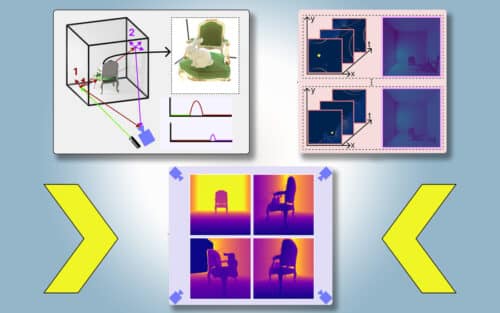
Plato-NeRF is a computer vision system that combines lidar measurements with machine learning to reconstruct a 3D scene, including hidden objects, from only one camera view by exploiting shadows. Here, the system accurately models the rabbit in the chair, even though that rabbit is blocked from view.
Credits:Credit: Courtesy of the researchers, edited by MIT News
Plato-NeRF is a computer vision system that combines lidar measurements with machine learning to reconstruct a 3D scene, including hidden objects, from only one camera view by exploiting shadows. Here, the system accurately models the rabbit in the chair, even though that rabbit is blocked from view. Credits:Credit: Courtesy of the researchers, edited by MIT News

Imagine you’re in an autonomous vehicle in a tunnel when traffic suddenly stops ahead due to a crash. Typically, your car would react based on the vehicle in front. But what if it could detect the halted traffic ahead and brake sooner?

- Advertisement -

Researchers from MIT and Meta have developed PlatoNeRF. This computer vision technique enables autonomous vehicles to detect obstacles beyond their direct line of sight by using shadows to create accurate 3D models of obscured areas. This method combines lidar with machine learning to improve 3D reconstructions, particularly in challenging lighting conditions. PlatoNeRF could also enhance AR/VR headsets and assist warehouse robots by allowing precise environment modelling without manual measurements.

Shedding light on the problem

The researchers have developed PlatoNeRF using single-photon lidar, which emits light pulses and measures their return time to map a high-resolution scene. This lidar illuminates a target point, and while some light returns directly, most scatter off other objects. PlatoNeRF captures this scattered light to gather more scene details, including depth and shadow information. It analyses secondary light rays that bounce from the target to other points, identifying shadowed areas to infer the geometry of hidden objects. By sequentially lighting 16 points and capturing multiple images, PlatoNeRF reconstructs the entire 3D scene.

A winning combination

PlatoNeRF hinges on the integration of multibounce lidar with a neural radiance field (NeRF), a type of machine-learning model that encodes a scene’s geometry into the weights of a neural network, enhancing its ability to interpolate or estimate novel views of a scene. Compared to two common alternatives—one using only lidar and the other only a NeRF with a colour image—PlatoNeRF outperformed both, mainly when the lidar sensor was of lower resolution. This makes PlatoNeRF more viable for real-world applications, where commercial devices often feature lower-resolution sensors.

- Advertisement -

In the future, the researchers plan to track more than two light bounces to enhance scene reconstructions and intend to incorporate deeper learning techniques and colour image data into PlatoNeRF to capture texture details.


Nidhi Agarwal
Nidhi Agarwal
Nidhi Agarwal is a Senior Technology Journalist at Electronics For You, specialising in embedded systems, development boards, and IoT cloud solutions. With a Master’s degree in Signal Processing, she combines strong technical knowledge with hands-on industry experience to deliver clear, insightful, and application-focused content. Nidhi began her career in engineering roles, working as a Product Engineer at Makerdemy, where she gained practical exposure to IoT systems, development platforms, and real-world implementation challenges. She has also worked as an IoT intern and robotics developer, building a solid foundation in hardware-software integration and emerging technologies. Before transitioning fully into technology journalism, she spent several years in academia as an Assistant Professor and Lecturer, teaching electronics and related subjects. This background reflects in her writing, which is structured, easy to understand, and highly educational for both students and professionals. At Electronics For You, Nidhi covers a wide range of topics including embedded development, cloud-connected devices, and next-generation electronics platforms. Her work focuses on simplifying complex technologies while maintaining technical accuracy, helping engineers, developers, and learners stay updated in a rapidly evolving ecosystem.

SHARE YOUR THOUGHTS & COMMENTS

EFY Prime

Unique DIY Projects

Electronics News

Truly Innovative Electronics

Latest DIY Videos

Electronics Components

Electronics Jobs

Calculators For Electronics