Tiny robots smaller than a grain of rice can sense, think, and move on their own. They could one day fix tissue inside the human body.
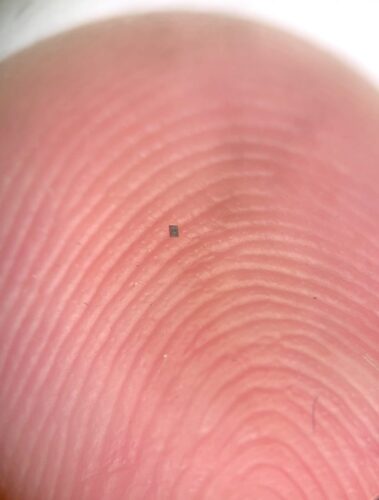
For decades, scientists have worked on creating microscopic robots for medicine, environmental monitoring, and manufacturing. But progress has been slow. Most existing microbots rely on large external systems like magnets or lasers and cannot act autonomously in new environments.
Tiny robots that can move on their own through the human body to fix damaged tissue may sound like science fiction. But researchers at the University of Pennsylvania and the University of Michigan have made a robot smaller than a millimeter, complete with its own computer and sensors, bringing this vision of microscale surgery closer to reality.
The team developed an autonomous, programmable robot smaller than a grain of rice by overcoming key technical challenges. Their breakthrough was embedding all necessary computing power directly onto the robot using standard semiconductor chip-making techniques, known as Complementary Metal-Oxide-Semiconductor (CMOS). This method lets researchers “print” sensors, processors, and actuators directly onto the robot, allowing hundreds to be manufactured at once on a single chip.
Each robot measures 210–270 micrometers across and includes tightly integrated systems: onboard photovoltaic cells that harvest light from LEDs, a processor, temperature sensors, and movement actuators.
To test autonomy, the robots faced a thermal gradient challenge in a fluid-filled dish, with one side cool and the other warm, while a light powered their photovoltaic cells. They were programmed to sense temperature changes: if it cooled, they moved in arcs to find warmer fluid; if it warmed, they stayed in place. Across 56 trials, the robots successfully adjusted their movements on their own.
The researchers highlight the advantages. Digital programming and onboard computing let a single microrobot perform a variety of tasks that can be reconfigured after production. Costs are also minimized, as embedding computation reduces both production and operational overhead, making widespread use more feasible.
Future work includes creating a fully integrated, wireless locomotion system so these microrobots can move without relying on an external light source, bringing them a step closer to potential medical applications inside the human body.