Imagine robots that can walk, roll, and fly, working together to reach places no single robot can. See how this system could change search, rescue, and more.
Robots face a major challenge: no single robot can navigate every type of terrain. Walking robots can’t fly or roll, flying robots can’t handle tight spaces or uneven ground, and rolling robots can’t overcome obstacles like ponds or stairs. This makes tasks such as search and rescue, or reaching hard-to-access areas, difficult to accomplish with conventional robots. Engineers need systems that can adapt to varied environments and reach locations no single robot could manage.
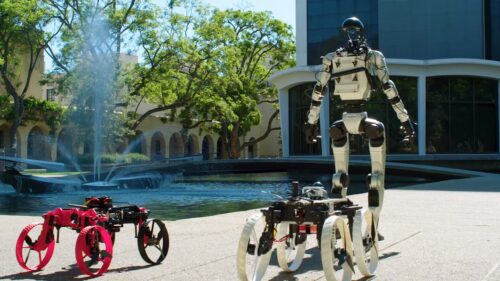
To tackle this problem, researchers at Caltech developed a multirobot system called X1. By combining teamwork between robots, X1 can walk, drive, and fly, giving it access to spaces other robots cannot reach. The system is built around the capable Unitree R1 humanoid robot, which carries an M4 robot on its back. This backpack robot isn’t just for looks: it can transform between rolling and flying modes depending on the terrain. The humanoid approaches an area, then deploys the M4 to continue the mission where it cannot go further.
In a demonstration on Caltech’s campus, the humanoid started inside a building, walked across campus, and deployed the M4 like a mechanical falcon taking flight. The M4 then transformed into driving mode to roll across the ground, switched back to flight to soar over a pond, and eventually reached a simulated emergency site.
This combination of walking, rolling, and flying allows X1 to navigate complex terrain in ways no single robot could handle. Physics-based control algorithms let the humanoid generate its own movements without relying on pre-recorded human motion, enabling it to adapt to challenging environments it hasn’t seen before.
The team’s long-term goal is to create autonomous robotic systems that are safe, reliable, and capable of operating independently in dynamic real-world environments. If successful, the X1 collaboration could bring about a new era of cooperative, adaptable robots—and, with luck, maybe they’ll fetch snacks too.