From smarter flight planning to personalised airport experience, AI is changing how we fly, often behind the scenes, but with a big impact you can feel.
Artificial intelligence (AI) is ushering in a new era for the aviation sector, transforming airline and airport operations across every layer of their systems. As air travel becomes more complex, requiring higher safety standards, greater operational efficiency, and an enhanced passenger experience, AI has emerged as a critical enabler in meeting these demands.

Across the aviation ecosystem, advanced AI technologies, such as machine learning, deep learning, natural language processing, computer vision, and robotics, now play a central role in functions ranging from flight planning to aircraft maintenance. AI enables airlines and airports to make real-time, data-driven decisions, reduce human error, and respond effectively to rapidly changing operational conditions. By optimising flight routes, strengthening maintenance processes, and enhancing customer engagement and security, AI has become indispensable to modern aviation systems.
As sustainability assumes greater global importance, AI is also helping the sector lower its environmental footprint through improved fuel efficiency and more effective resource allocation.
AI systems can process and analyse vast datasets to generate insights that were previously inaccessible, allowing stakeholders to forecast trends, prevent incidents, and ensure smoother travel experiences. In addition, the adoption of AI helps address workforce shortages in areas such as air traffic control and maintenance by automating repetitive tasks and supporting human decision-making.
This article explores advanced applications of AI in the aviation sector, offering a detailed examination of how these technologies are shaping the future of air travel.
Applications of AI in the Aviation Sector
Predictive Maintenance
One of the most significant AI-driven advancements in aviation is predictive maintenance, which replaces conventional schedule-based maintenance practices with real-time, data-informed predictions. Instead of relying on fixed inspection intervals, airlines now use AI algorithms to assess the condition of aircraft components and anticipate potential failures before they occur. This proactive approach reduces the risk of unexpected breakdowns, improves aircraft availability, lowers maintenance costs, and enhances operational safety.
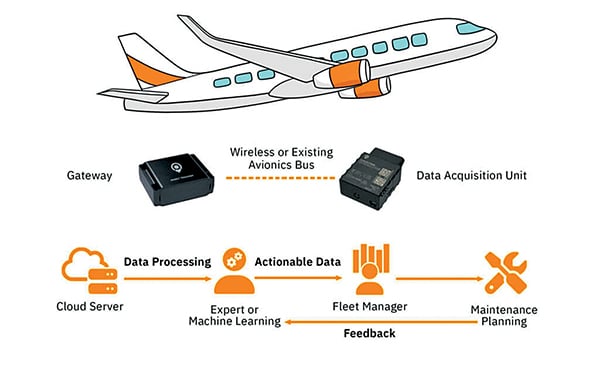
At the core of predictive maintenance is the ability of AI systems to analyse large volumes of data collected from onboard sensors monitoring engine temperature, vibration levels, hydraulic pressure, and fuel efficiency. Machine learning algorithms continuously examine these data streams to identify patterns and anomalies that may indicate emerging faults.
A notable example of predictive maintenance implementation is the collaboration between Southwest Airlines and AIXI, an AI startup specialising in aircraft system diagnostics. Through this partnership, Southwest has equipped its fleet with AI-driven analytics tools capable of real-time monitoring of critical systems. Data from engines, landing gear, braking systems, and other components are continuously transmitted and analysed. When anomalies are detected, such as unexpected turbine vibrations or reduced hydraulic pressure, the system flags the issue and recommends targeted maintenance actions. As a result, Southwest has significantly reduced unplanned maintenance-related delays, improving both customer satisfaction and operational efficiency.
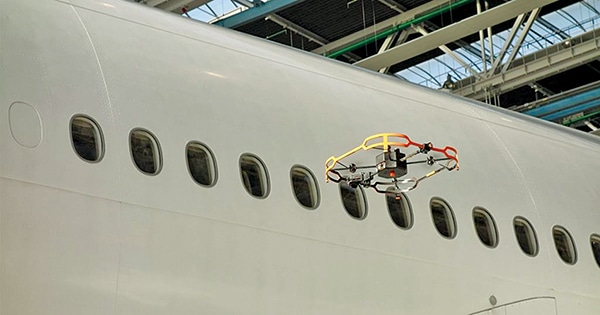
Another notable deployment can be seen at Air France Industries, which has adopted autonomous drones developed by the French technology company Donecle. These drones, equipped with AI and computer vision capabilities, perform detailed visual inspections of aircraft exteriors. Traditionally, such inspections required several hours and involved technicians manually examining the fuselage, wings, and tail using scaffolding or lifts. Donecle’s drones can now scan an entire narrow-body aircraft in under an hour. Using high-resolution imaging and advanced deep learning algorithms, they accurately detect surface anomalies such as lightning strikes, paint degradation, and structural cracks.
Flight Operations Optimisation