




Struggling with unclear images in low light? These area image sensors can give fast and accurate results for industrial, farm, and food inspections. Find out more.
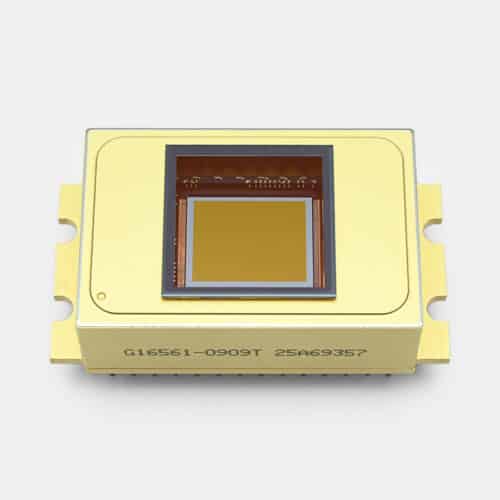
Industrial and scientific imaging often faces significant challenges when detecting faint signals in low-light or variable lighting conditions. In agriculture, food safety, and plastics sorting, inconsistent imaging can lead to errors in quality control. Semiconductor inspection and hyperspectral imaging also demand high sensitivity and fast data capture. However, conventional sensors are often limited by thermal noise, slow readout speeds, and insufficient dynamic range, making it difficult to achieve accurate, real-time monitoring and reliable results.
To address these challenges, Hamamatsu Photonics has launched new InGaAs area image sensors. These sensors feature high dynamic range, very low dark current, and frame rates up to 116 fps. Integrated 3-stage thermoelectric cooling reduces noise for precise low-light and infrared detection, while multi-line readout ensures fast, flexible performance suitable for applications such as agri-photonics, plastic sorting, and food safety spectroscopy.
These sensors are suitable for near-infrared, non-destructive inspection, including farm produce and semiconductor inspection, as well as hyperspectral imaging tasks like plastic sorting and food screening. They can also be used for traffic monitoring, delivering reliable performance across diverse industrial and safety applications.
Some of the key features of the InGaAs area image sensors include:
- Spectral response from 0.95 μm to 1.69 μm
- 640 × 512 pixel near-infrared sensor
- Dynamic range: 3500
- 4-port analog output
- Three-stage TE-cooled type
Designed for engineers and R&D teams tackling complex industrial challenges, these InGaAs area image sensors deliver consistent, high-quality images even in low or changing light conditions. They support rapid, real-time data capture at up to 116 fps, offer exceptional sensitivity for detecting faint signals due to ultra-low dark current, and provide flexible integration with multi-line readout. Advanced 3-stage cooling further ensures reliable performance in demanding environments by minimizing thermal noise.

