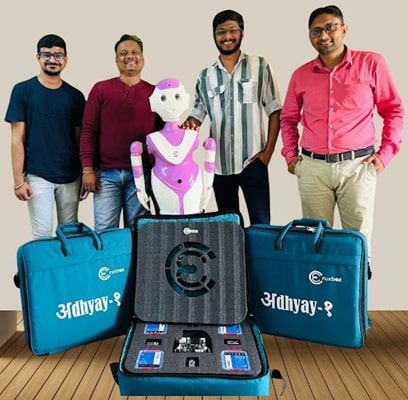


Transforming basic robotics kits, a student-led startup is redefining a complete learning path, from beginner projects to AI-powered machines. How is that possible? Hitendra Valhe and Bhagyesh Tajne of Ecruxbot tells their story to EFY’s Nidhi Agarwal.

Q: What does your company do?
A: We started the company in our second year of college with a focus on Robot Operating System 2 (ROS2)–based autonomous robots and navigation for both industrial and customer-oriented applications. Our initial goal was to develop indigenous robots. Over time, we realized that the education sector offered a more stable business model, which led us to develop structured learning platforms alongside our core robotics work.
Based on market research, we launched our first product, Adhyay 1, for medium and advanced education segments. This was followed by Adhyay Advance, which takes learners from basic robotics concepts to advanced machine learning (ML) and artificial intelligence (AI) on hardware, offering a clear pathway for anyone aiming to build a career in robotics.
Q: What is your educational kit?
A: Most do-it-yourself (DIY) robotics kits available in India are basic and designed mainly for schools. Our kit is built to take learners from beginner to advanced levels, including AI and ML directly on hardware.
The motherboard allows up to four development boards: Arduino Nano, Raspberry Pi Pico, STM32, and ESP32, to be used interchangeably. This means learners do not need to buy new kits as they progress. The board also includes built-in sensors for Internet of Things (IoT) applications, connectivity, and Tiny ML, a combination that is currently not available in other Indian kits.
Unlike conventional kits that support only a single controller and cost between ₹10,000 and ₹15,000, our system integrates four controllers into one platform, making it suitable for school students, college students, and robotics or IoT learners alike.
Q: What problem do the four microcontrollers in a single kit solve?
A: The four microcontrollers give learners flexibility based on their experience level and coding preferences. The ESP32 can handle most applications, but some users prefer starting with Arduino Nano. The Raspberry Pi Pico is included as a compact, Arduino-like board rather than a full single-board computer.
Learners can begin with basic C programming on ESP32 using the Arduino Integrated Development Environment or the Espressif Internet Development Framework, and even explore MicroPython. As they advance, they can move to STM32, which is widely used in industry. Working across multiple controllers on a single platform gives users strong hands-on experience with embedded systems.
The kit also includes a complete Learning Management System manual, videos, and open-source courses covering basic and intermediate levels.
Q: What sensors and features does the kit provide?

A: The kit includes built-in sensors on the Arduino nano bluetooth low energy sense board, such as a gyroscope, microphone, and colour sensor. It also supports external sensors like ultrasonic distance sensors, DHT sensors for temperature and humidity, accelerometer and magnetometer modules, and temperature sensors.
The board is upgradeable, allowing users to add new sensors as needed in the future.
Q: Who is your current target audience?
A: At present, our primary focus is Business-to-Business. We work mainly with schools, private course providers, and institutions, including engineering and science colleges. While individual robotics learners also use the kit, Business-to-Consumer options will be made available online at a later stage.
Q: What applications can users build with the kit?
A: Users can work on a wide range of projects, from basic to advanced applications. For example, similar to a digital magic slate, users can write on a mobile device and display it on a robot’s light emitting diode screen, then erase it with a click.
They can also build line-following robots, basic autonomous navigation systems using ultrasonic sensors, and IoT applications controlled through Bluetooth or Wi-Fi. The kit supports more than 100 practical experiments, including playing audio from a SD card, FM radio projects, and controlling devices using a remote or mobile application. Beyond these, users are encouraged to explore their own ideas and custom projects.
Q: How does the kit help users learn hardware, and what basic courses do you offer?
A: Our basic courses start with hands-on components such as servo motors and DC motors. We explain how these components work, when drivers are required, and why they are necessary. For instance, the DC motor included in the kit is an encoder motor, which allows users to track rotations accurately.
The courses cover foundational concepts such as voltage, current, and resistance, and then apply them through experiments using the kit. This approach allows even beginners with basic knowledge of electricity to understand how hardware components work in real-world applications.
Q: Since your kit includes AI and ML, what challenges did you face during integration?
A: One major challenge was that standard libraries used for ML, such as NumPy, do not work on microcontrollers. To overcome this, I developed a custom mathematics library that supports functions like stochastic gradient descent, backpropagation, and data filtering. Although the library is basic, it enables Tiny ML on small devices.
Another challenge was hardware limitation. Unlike laptops, microcontrollers have very limited random access memory (RAM), typically ranging from 2 kilobytes to 1 megabyte, and cannot handle continuous data streams in conventional training methods. Ready-made libraries such as pandas, NumPy, and scikit-learn had to be modified and consolidated into a single lightweight library suitable for embedded controllers. Since this library is open-source, others can use it without facing the same constraints.
Q: With AI taking over many tasks, why is learning coding still important?
A: Even with AI tools, coding remains essential. AI can generate code, but it does not test or guarantee flawless execution. To understand, debug, or modify that code, users still need a solid grasp of programming logic and languages. As applications become more advanced, coding skills will continue to be a critical requirement.
Q: What gaps exist between college education and job requirements, and how can they be addressed?
A: The biggest gap is in practical skills. Leading engineering colleges excel because they offer strong labs, hands-on training, and industry exposure, not just theoretical teaching. Fields such as robotics and drones are difficult to learn without access to expensive equipment.
By providing students with hands-on experience across multiple controllers and real-world applications, structured kits like ours help fill this void and make students more industry-ready without requiring additional external courses. We can say that we are bridging the gap between college labs and real world robotics.
Q: What challenges did you face while developing the kit, and how did you solve them?
A: In the early versions, we faced several issues, including circuit errors, memory limitations, and buffer problems with the SD card. Initially, no one on the team had experience in Printed Circuit Board design, so one team member learned it and redesigned the boards.
Each iteration addressed issues from the previous version. We also relied on community forums, mentors, and feedback from students during workshops. By the fifth version, the major problems were resolved, and the product was stable for launch.
Q: How do you stay updated with new technologies and decide what to add to your product?
A: We rely on guidance from mentors and regularly follow learning resources that focus on current and future technologies. Much of our learning comes from online platforms such as Udemy and similar courses. We also track industry trends through technical articles and news to identify developments that can be integrated into our products.
Q: Where do you manufacture your kit, and how do you manage production?
A: We operate one facility in Jalgaon and another in Pune. While we handle design in-house, manufacturing is outsourced. This comes with challenges, particularly in vendor coordination. Delays sometimes occur when suppliers confirm availability but fail to deliver on time.
Despite these challenges, we manage to fulfill approximately 90 to 95 per cent of orders on schedule, with the remaining orders completed after short delays.
Q: What are your plans for scaling the business?
A: You see, Adhyay 1 was developed to ensure financial stability as we are a bootstrapped company. Our long-term goal remains the development of industrial robots, particularly navigation systems similar to those used in autonomous platforms.
We are also working on a new product called Arya, a receptionist robot that integrates AI, ML, image recognition, and voice interaction. The product is currently under development, and we already have confirmed orders that will be fulfilled once it is ready.
Q: Are you hiring, and what skills do you look for?
A: Our focus is on building industrial and ROS–based robots. One challenge we face is finding candidates with the right skill set. We look for a strong foundation in electronics and coding, with particular emphasis on knowledge of the ROS. Candidates with these skills can quickly integrate into our development process, as all our work is built on that platform.