




KAIST’s red micro-LED advancement pushes AR/VR visuals toward ultra-high resolution and energy-efficient electronics.
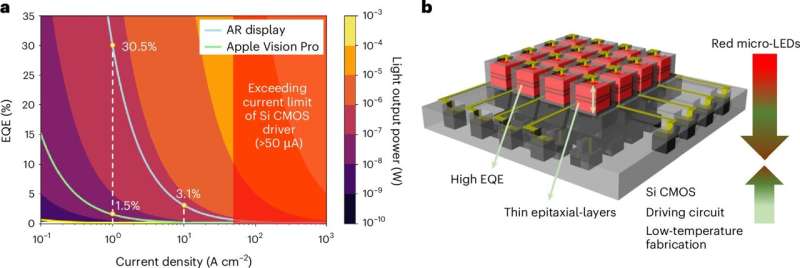
High-resolution, energy-efficient display tech has taken a significant step forward as researchers at the Korea Advanced Institute of Science and Technology (KAIST) demonstrated a new class of red micro-LED displays that tackle long-standing barriers in next-generation electronics, particularly for augmented and virtual reality devices.
The central challenge in advancing micro-LED technology has been twofold: maintaining high efficiency in tiny red pixels and integrating them reliably with driving electronics at very small scales. Red micro-LEDs tend to lose performance as pixel sizes shrink due to energy leakage, and conventional manufacturing that places millions of microscopic LEDs individually increases defects and limits resolution.
To address this, the research team developed an advanced AlInP/GaInP quantum-well structure that significantly reduces energy loss even as pixel dimensions decrease, enabling brighter, more efficient red light emission. Alongside this material innovation, they used a monolithic three-dimensional integration technique, stacking the LEDs directly onto driving circuitry. This method cuts alignment errors and defects while supporting ultra-high pixel densities.
The result is a micro-LED display achieving about 1,700 pixels per inch (PPI) roughly three to four times the resolution of flagship smartphone screens pushing visual detail toward what some describe as “reality-like” visuals. Micro-LED technology is already known for outperforming traditional display types like LCD and OLED in brightness, longevity and power efficiency, thanks to each pixel emitting its own light. But realizing full-color, high-density displays especially for red light has been a bottleneck for AR/VR applications, where pixel imperceptibility is essential to immersive experience. This work directly confronts those hurdles.
Beyond AR and VR headsets, the implications extend to wearables, automotive head-up displays, and other compact electronics where high-resolution visuals at low power are critical. By marrying novel semiconductor structures with scalable integration techniques, this breakthrough could accelerate the adoption of micro-LEDs in mainstream electronic display systems inching closer to seamless, immersive visual experiences in everyday devices.

