

Full-brick design pushes 2.1 kW/in³ power density to support next-gen HVDC AI infrastructure.
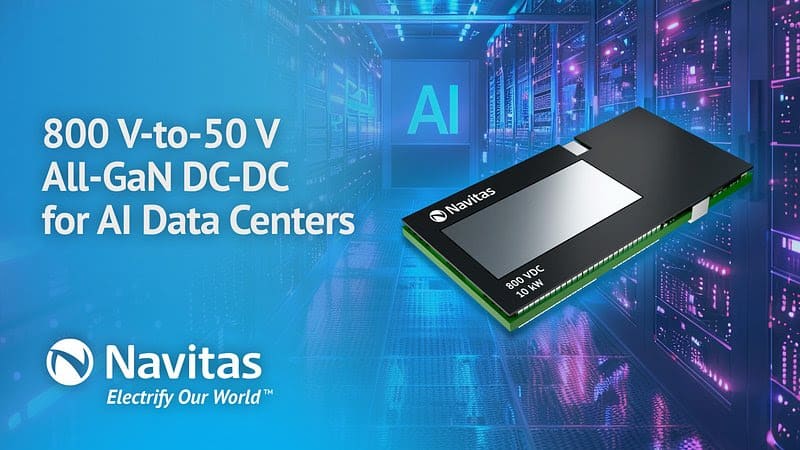
A new 10 kW DC-DC power platform by Navitas Semiconductor is aiming to accelerate the shift toward 800 VDC architectures in AI data centers, delivering up to 98.5% peak efficiency and 2.1 kW/in³ power density in a compact full-brick footprint.

Designed for next-generation high-voltage DC (HVDC) infrastructure, the all-GaN solution converts 800 V to 50 V and supports ±400 V to 50 V topologies targeting the escalating power demands of AI workloads. The platform achieves 98.1% efficiency at full load and operates at a switching frequency of 1 MHz, enabling smaller magnetics, reduced cooling requirements, and higher system density.
The key features are:
- 10 kW DC-DC conversion for 800 V–to–50 V and ±400 V–to–50 V architectures
- Up to 98.5% peak efficiency; 98.1% at full load
- 2.1 kW/in³ power density in full-brick (61 × 116 × 11 mm) format
- 1 MHz switching frequency using 650 V and 100 V GaN FETs
- Three-level half-bridge topology with integrated auxiliary power and control
At the heart of the design is a three-level half-bridge architecture using 650 V and 100 V GaN FETs with synchronous rectification. The approach is engineered to reduce switching losses while maintaining high-frequency performance, helping data center designers manage thermal constraints as rack power levels continue to rise.
Housed in a standard 61 × 116 × 11 mm full-brick form factor, the platform integrates auxiliary power and control circuitry to simplify system implementation. The production-oriented design is intended to ease adoption of 800 VDC distribution as operators look to improve efficiency and scalability in large AI clusters.
The introduction comes as hyperscale and enterprise data centers evaluate higher-voltage distribution schemes to handle projected compute growth, with some estimates suggesting AI queries could require orders of magnitude more power than traditional workloads. By combining high efficiency with high power density, the new platform is positioned to support faster, cooler, and more sustainable AI infrastructure rollouts. The system is currently undergoing evaluation with select data center customers, with broader industry demonstrations planned in the coming months.